
- Opinion Articles
- The Makkah Defense Agreement: A Trilateral Pact or the Beginning of NATO 2.0 for the Muslim World?
The Makkah Defense Agreement: A Trilateral Pact or the Beginning of NATO 2.0 for the Muslim World?
Leeza Elahi
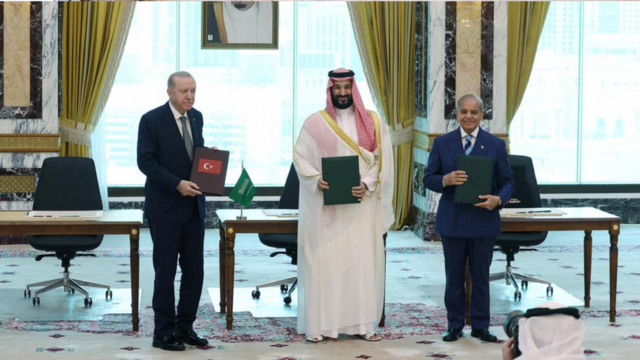
In order to strengthen military cooperation, the Islamic Republic of Pakistan and the Kingdom of Saudi Arabia made an agreement known as the Strategic Mutual Defense Agreement (SMDA), which was signed in September 2025 in Riyadh. The key provision was that an attack on either country would be considered an attack on both. The major objective of that agreement was mutual defense, intelligence sharing, deterrence and military cooperation. Nearly a year later, the security framework was expanded into a trilateral agreement when Pakistan, Saudi Arabia and Türkiye signed the Makkah Joint Defense Agreement on 7 August 2026. Türkiye has now joined the framework as part of this defense pact. The Makkah agreement does contain the collective defense principle that an attack on one is treated as an attack on all three.
This collective defense principle bears a notable resemblance to Article 5 of NATO. However, resemblance does not mean equivalence. NATO is a highly institutionalized transatlantic political and military alliance, whereas the Makkah agreement is currently a much smaller trilateral security agreement. This development, therefore, raises broader strategic questions: Did Pakistan and Saudi Arabia intend to create a "NATO 2.0" for the Muslim World? Is the Makkah defense agreement simply a trilateral security agreement, or could it become the foundation of a collective security alliance for the Muslim world? Could other Muslim-majority states eventually join such a framework? Is this a trilateral defense agreement or the beginning of something new?
The transition from the 2025 defense pact to the 2026 Makkah framework represents more than the addition of another country. It expands the partnership's strategic scope. Pakistan has considerable military capabilities, strategic value and decades of defense co-operation with Saudi Arabia. Saudi Arabia can contribute through its economic strength, geopolitical influence, and central position in the Middle East. At the same time, Türkiye can play a major role through its defense industry, armed capabilities and strategic location connecting Europe, the Middle East and Asia.
Together, these three states have complementary strategic strengths. Their cooperation has the potential to develop beyond traditional bilateral defense relations. However, it is important not to overemphasize the development because it is still new and unlike NATO, it does not yet have NATO's institutional structure, command mechanisms and decades of military coordination. The current pact is therefore better understood as an emerging collective defense framework rather than an established military alliance comparable to NATO.
Also read: From Bilateral Ties to Trilateral Deterrence: The “Makkah Joint Defence Agreement"
The comparison with NATO arises primarily from the principle of "Collective Defense." NATO's Article 5 says that an armed attack against one member is considered an attack against all. It is the fundamental principle which explains NATO's collective defense and deterrence. The Makkah agreement contains a striking principle. An attack on one of the three participating states is to be regarded as an attack against all three. This creates deterrence by capability: a potential aggressor must consider not only one state's military capabilities but the combined response of three strategically important countries.
Yet similarity is not enough to make the two agreements identical. NATO has 32 members, permanent political and military structures, established procedures and decades of institutional development. The Makkah framework currently has only 3 members and remains in its early stages. Therefore, "NATO 2.0" should be treated as a question for analysis, not a description of an existing reality. The three states' strategic interests help explain the agreement. For Pakistan, closer defense cooperation with Saudi Arabia and Türkiye strengthens its strategic partnerships beyond South Asia. Pakistan already maintains long-standing military ties with Saudi Arabia, while its relationship with Türkiye has expanded considerably in defense and strategic cooperation.
Also read: The Islamabad Memorandum: Pakistan’s Diplomatic Triumph
For Saudi Arabia, the agreement can be seen as part of a broader effort to strengthen its security partnerships and diversify its strategic relationships. Rather than relying entirely on external powers for security, Riyadh can benefit from cooperation with regional and Muslim-majority powers with significant military capabilities. For Türkiye, participation provides an opportunity to deepen its strategic role in the Middle East while strengthening relations with two major Muslim states. Türkiye's defense industry and military experience also add significant value to the partnership. The agreement, therefore, appears to serve the interests of all three countries, although their motivations are not necessarily identical.
This is perhaps the most important question for the agreement's future: Could other Muslim states join? A genuine "Muslim NATO" would require participation beyond three states. However, expansion would not be easy. Muslim-majority states have different national interests, security concerns, foreign policy orientations, and relations with major powers. Some maintain close relations with the United States, China, Russia and other regional actors, while others have competing interests with one another. Therefore, the greatest challenge may not be military capability but political consensus. For a broader alliance to emerge, the participating states would need to agree on what constitutes a threat, when collective defense should be activated and whether members would be willing to defend one another during a crisis.
Despite its potential, several obstacles could prevent the emergence of "NATO 2.0". First, different national interests can make collective decision-making difficult. What one country considers may not be viewed the same way by another. Second, leadership can become a sensitive issue. A broader Muslim defense alliance would have to determine who leads it, where its headquarters would be located and how military decisions would be made. Third, institutional development and advancement would be essential. NATO's power comes not from Article 5, but from years of military cooperation, joint exercises, command structures, and strategy. Finally, the agreement would need to demonstrate its credibility, which is possible through implementation. The real test of a collective defense agreement is not the signing ceremony but how its members respond when one of them faces a security crisis.
Also read: Is the U.S.–Israel War on Iran Dividing the Muslim World?
To conclude, the Makkah Joint Defence Agreement is undoubtedly a significant development regarding security in the Muslim world. Nevertheless, calling it "NATO 2.0" at this stage would be wrong. NATO is a deeply rooted institutional alliance built over decades, whereas the Makkah framework is still in its beginning. The more important question, therefore, is not whether the Makkah Agreement is already a Muslim NATO, but whether it could become the starting point for one. If more Muslim-majority states join the agreement, not only will political trust develop among them, but members will also show their genuine willingness to defend one another. The Makkah framework could evolve into a broader collective security architecture. For now, this agreement should be viewed as a potential beginning rather than a finished alliance. Its future depends on whether they can transform a shared commitment into a sustainable system of collective security, but not simply on how many countries sign it.
Disclaimer: The views expressed in this article are solely those of the author and do not necessarily reflect the official stance of The Himalayan Research Institute Pakistan (THRIP)
_________________________________
Leeza Elahi is a Master's degree holder in International Relations from Bahauddin Zakariya University, Multan, Pa
Contact us

Write with Us
The Himalayan Research Institute is proud to introduce "Himalayan," a dynamic and insightful magazin...
- [email protected]
- +923426470466
- website