
- Opinion Articles
- From Bilateral Ties to Trilateral Deterrence: The “Makkah Joint Defence Agreement"
From Bilateral Ties to Trilateral Deterrence: The “Makkah Joint Defence Agreement"

Waqas Abdullah
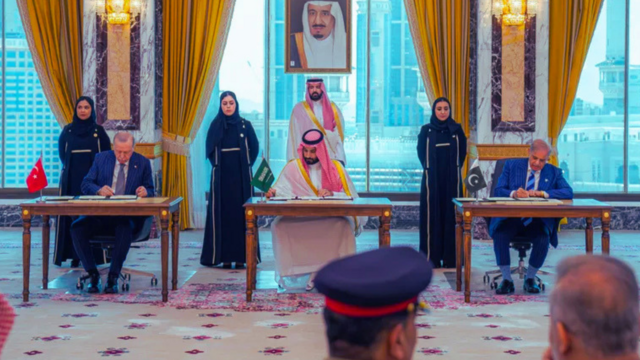
The signing of the Pakistan–Saudi Arabia–Türkiye Joint Defence Agreement marks a significant development in the evolving security architecture of the Middle East and its surrounding regions. Signed in Makkah on 7 August 2026, the agreement brings together three strategically important states with substantial military, diplomatic and economic capabilities. Its most consequential principle is that an armed attack against any one of the three countries will be regarded as an attack against all three, establishing a framework for collective deterrence and defence cooperation.
The agreement is important not simply because three countries have decided to strengthen military ties, but because it reflects a broader transformation in regional security. For decades, the Middle Eastern security environment has been heavily shaped by external powers, particularly the United States. However, growing regional instability and uncertainty have encouraged states to diversify their strategic partnerships and develop greater capacity to protect their own interests.
The Pakistan–Saudi Arabia–Türkiye agreement can therefore be understood as part of this wider movement toward regional strategic autonomy.
From Bilateral Cooperation to Trilateral Deterrence
Pakistan and Saudi Arabia already possess a longstanding defence relationship. Their military cooperation has included training, defence exchanges and security coordination for decades. In September 2025, Islamabad and Riyadh further institutionalised this relationship through the Strategic Mutual Defence Agreement, which established that aggression against either country would be considered aggression against both. The 2026 trilateral agreement builds upon this existing foundation by bringing Türkiye into the security framework. Türkiye's participation significantly expands the strategic potential of the arrangement. Pakistan possesses extensive military experience and nuclear deterrence capabilities. Saudi Arabia contributes substantial economic resources, strategic geography and its central position in the Gulf and wider Arab world. Türkiye brings one of the region's most capable conventional militaries, NATO experience and a growing indigenous defence industry. The result is a partnership based on complementary rather than identical capabilities. Its significance therefore lies in the combination of Pakistani military capacity, Saudi strategic and economic weight, and Turkish defence and technological capabilities.
Also read: MBS’s Offensive Diplomacy: Saudi Arabia’s Bid for Gulf Supremacy
A New Regional Security Architecture
The agreement comes at a time when the traditional security architecture of the Middle East is undergoing considerable change. Regional states are increasingly seeking to develop multiple partnerships rather than relying exclusively on a single external security provider. The new trilateral arrangement should not automatically be described as an "Islamic NATO." Such a comparison would exaggerate the agreement's present institutional structure. Instead, it is more accurate to describe it as an emerging framework for regional collective deterrence. Its geographical implications are particularly important. Pakistan connects the Gulf with South Asia and the Arabian Sea. Saudi Arabia occupies a central position between the Gulf and the Red Sea. Türkiye provides a strategic bridge between the Middle East, Europe, the Mediterranean and the Black Sea. Cooperation among these three states therefore connects several strategically important regions. This could gradually produce a more interconnected security environment in which developments in the Gulf, South Asia and the eastern Mediterranean are increasingly considered part of a broader strategic equation.
Saudi Arabia's Search for Strategic Autonomy
For Saudi Arabia, the agreement represents an important extension of its evolving foreign and security policy. Riyadh has traditionally relied heavily on its defence relationship with the United States. However, recent geopolitical developments have encouraged Saudi Arabia to diversify its strategic partnerships while maintaining its relationship with Washington. This diversification does not necessarily mean that Saudi Arabia is abandoning the United States. Rather, it reflects a desire to increase strategic flexibility. The Kingdom has simultaneously strengthened relations with Türkiye, Pakistan, China and other international actors while pursuing diplomatic engagement with regional rivals. The trilateral defence agreement fits naturally within this approach. By deepening defence cooperation with Pakistan and Türkiye, Saudi Arabia gains additional strategic options. Pakistan provides military depth and longstanding defence expertise, while Türkiye offers advanced defence capabilities and an increasingly powerful indigenous military-industrial sector. For Riyadh, therefore, the agreement is not simply about preparing for conflict. It is also about ensuring that Saudi Arabia has multiple strategic options when responding to future crises.
Pakistan's Emerging Strategic Role
For Pakistan, the agreement carries significance beyond its traditional relationship with Saudi Arabia. Islamabad has maintained close defence relations with Riyadh for decades, but Türkiye has also become an increasingly important strategic partner. Defence cooperation between Pakistan and Türkiye has expanded in areas including naval capabilities, defence technology and military cooperation. The trilateral agreement brings these two relationships together within a single strategic framework. Pakistan consequently finds itself occupying an increasingly important position between South Asian and Middle Eastern security environments. This is particularly significant because Pakistan has historically maintained relations with countries that do not always share the same geopolitical interests. Islamabad has close strategic ties with China, strong defence relations with Türkiye and Saudi Arabia, and continues to maintain diplomatic engagement with Iran and other regional states. This diplomatic flexibility could make Pakistan an important factor in regional crisis management. However, Islamabad will also need to carefully balance its relationships. Its geographical proximity to Iran means the trilateral arrangement must not become a source of unnecessary confrontation with Tehran. The agreement's defensive character and Pakistan's continued emphasis on regional stability will therefore remain important.
Also read: The Islamabad Memorandum: Pakistan’s Diplomatic Triumph
Türkiye's Expanding Defence Footprint
Türkiye's role adds another strategic dimension to the agreement. Over the past decade, Ankara has increasingly developed its own defence-industrial capabilities and expanded its strategic engagement across the Middle East and beyond. Turkish drones, naval platforms and other defence technologies have increased Ankara's influence in regional security affairs. Türkiye also has NATO experience, providing it with institutional knowledge of alliance-based military coordination and interoperability. Its participation, therefore, strengthens the technological and conventional military dimensions of the trilateral partnership. For Ankara, the agreement also deepens ties with two strategically important Muslim-majority states. It provides an additional platform for defence cooperation while reinforcing Türkiye's broader role as an independent regional power.
Also read: The New Caliphate Question: Can Türkiye Lead the Islamic World?
Deterrence Does Not Necessarily Mean War
The most important question is whether this agreement will increase or reduce the possibility of conflict. At first glance, a collective defence arrangement may appear escalatory. However, the fundamental purpose of deterrence is to prevent aggression by increasing the potential costs of aggression. If a potential aggressor knows that military action against one member could trigger a coordinated response from three countries, the calculation becomes more complicated. This is the central logic of collective deterrence. The agreement should therefore not automatically be interpreted as an offensive military bloc. Its declared purpose is defence cooperation and deterrence. Its strategic value lies in making aggression more costly and therefore potentially less attractive. In this sense, stronger defence cooperation can coexist with diplomacy. Indeed, effective deterrence and diplomacy are not necessarily competing strategies. They can reinforce one another. A state with credible defensive capabilities often possesses greater diplomatic leverage because it can negotiate from a position of greater confidence.
Implications for Iran and the Wider Gulf
The agreement will inevitably attract attention in Tehran because of the strategic positions of the three countries. However, it would be simplistic to label the pact an anti-Iran alliance. Pakistan has historically sought constructive relations with Iran, while Türkiye maintains extensive diplomatic and economic engagement with Tehran. Saudi Arabia itself has recently pursued diplomatic engagement with Iran after years of rivalry. These realities suggest that the trilateral arrangement does not necessarily eliminate diplomatic space. Instead, its primary objective may be to strengthen deterrence while preserving room for dialogue. If the agreement is interpreted as a defensive mechanism designed to prevent aggression, it could contribute to stability. If it is interpreted as an exclusive bloc against specific regional actors, it could instead intensify geopolitical competition. The choices made by Islamabad, Riyadh and Ankara will determine which of these outcomes becomes more likely.
Also read: What if the Khamenei Regime Falls: Geopolitical Implications for the Region
The Road Ahead
The agreement is significant, but its ultimate effectiveness will depend on implementation. Political declarations must eventually be translated into practical mechanisms such as joint exercises, intelligence cooperation, military interoperability, defence technology partnerships and crisis communication. The three countries will also need to manage differences in their foreign-policy priorities. Pakistan's relationship with Iran, Saudi Arabia's relations with global powers and Türkiye's independent regional diplomacy mean that the three states will not always have identical strategic interests.
Successful strategic cooperation does not require complete agreement on every issue. It requires sufficient common interests to sustain cooperation when circumstances become difficult. The Pakistan–Saudi Arabia–Türkiye defence pact therefore represents the beginning of a strategic process rather than its final form. If effectively implemented, it could contribute to a more diversified Middle Eastern security architecture in which regional powers possess greater capacity to deter aggression and respond collectively to emerging threats.
Disclaimer: The views expressed in this article are solely those of the author and do not necessarily reflect the official stance of The Himalayan Research Institute Pakistan (THRIP)
_________________________________
Waqas Abdullah is a geopolitical analyst and anthropologist with expertise in Middle Eastern and Indo-Pacific politics. A Türkiye Bursları Scholar, he is pursuing a Master’s in International Relations at Selçuk University, Konya, Türkiye. Director of Foreign Affairs at DAG Media Network. His work focuses on climate refugees, human security, and regional cooperation.
Contact us

Write with Us
The Himalayan Research Institute is proud to introduce "Himalayan," a dynamic and insightful magazin...
- [email protected]
- +923426470466
- website