
- Opinion Articles
- The Two Gates of Crisis: Fragility of Global Economy and Energy Shocks
The Two Gates of Crisis: Fragility of Global Economy and Energy Shocks
Dur e Adan
The international shipping industry relies on miles of invisible sea routes, with over 80% of internationally traded goods shipped across oceans. Modern consumer society assumes supermarket shelves will always be stocked, electric grids will never fail, and goods will always move through the supply chain. Although the global system is interconnected, it depends on sea lanes that pass through maritime choke points. When challenges arise at a choke point, they cause local logistics disruptions; when two choke points are contested at the same time, the international economy can face a worldwide crisis, with fuel shortages and global logistics disruption.
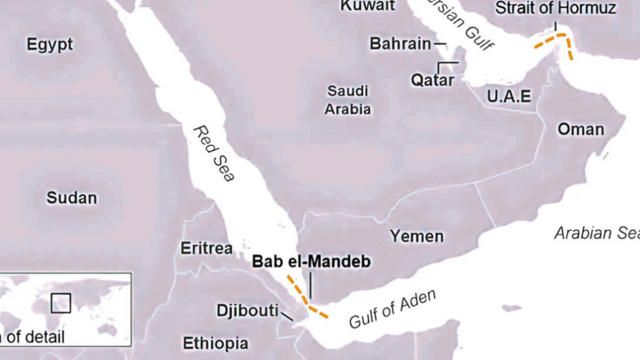
To understand the gravity of the dual chokepoint crisis, one must look at the opposing but complementary functions that the two waterways perform in the international trade system. The Strait of Hormuz controls access to the Persian Gulf, ensuring that about 20-21 million barrels of crude oil and oil-derived liquids transit through it daily, amounting to 20 per cent of global oil consumption, along with a sizeable share of liquefied natural gas exports. Because there are no deep, navigable alternatives to the Hormuz Strait, when it is closed or disputed, oil from Saudi Arabia, Iraq, Kuwait, the United Arab Emirates, and Iran is effectively stuck on the Gulf shores. In contrast, Bab-el-Mandeb is the southern opening point to the Red Sea and the Suez Canal, and about twelve per cent of total world trade from Asia to Europe passes through it. The crisis in the Strait of Hormuz damages both pipelines, as the global economy loses the energy and manufacturing capacity associated with this conduit.
Also read: Geopolitics of the Red Sea: How Somali-land Reshaped Regional Alignments
The immediate outcome of this crisis is extremely serious and damaging for the global economy. Oil has long driven production, and its shortage triggers a chain reaction across the chemical industry, plastic production, fertilisers used in farming, electricity production, and transportation. In addition, the existence of reserves held by important economies can serve as a very temporary solution to the situation. Thus, heavy price increases are observed on the global oil market. The price hike affects vulnerable and growing countries which heavily rely on energy imports because this leads to the loss of their foreign currency reserves, depreciation of their own currency, and inflation of social goods. Central banks worldwide, having faced constant price fluctuations, cannot but pursue strict monetary policy, thus raising the rate of interest in order to limit inflation, yet it negatively impacts economic development and investments in wealth-generating activities.
Apart from direct military strikes or physical blockades, modern naval warfare imposes a complex financial impediment called risk tax, according to maritime logistics. Whether cargo vessels, bulk carriers, or oil tankers, commercial ships must operate under tight profit margins and cannot navigate conflict zones or missile-threat corridors without special war-risk insurance to cover the risk. In times of intense regional conflicts, international insurance syndicates quickly revalue the risk associated with sailing through a conflict area, increasing the insurance premiums from almost nonexistent during peacetime into significant surcharges of a couple of per cent of total vessel replacement cost just for one trip. For contemporary LNG carriers or crude supertankers worth more than $100 million, even millions of dollars in additional insurance per trip can turn profitable shipments into heavy losses. In light of this, shipowners and fleet operators often decide to halt or even stop their activities altogether, leading to a complete standstill in maritime transportation without aggressive naval forces implementing an actual blockade.
An additional factor aggravating the situation is a simultaneous shutdown or disruption of Bab-el-Mandeb, undermining global container logistics. In the case of the southern route becoming impassable due to conflict in the region or naval clashes and drone or missile threats, shipping companies are obliged to completely abandon the Suez Canal shortcut. Because of the closure of the Suez Canal, cargo carriers must reroute their fleet southwards around the Cape of Good Hope in Africa, resulting in a trip taking at least 10-14 extra days from Asia to Europe. This long journey requires the covering of an extraordinary number of nautical miles, which calls for considerable fuel consumption at precisely the time when fuel prices are rising around the world due to the events in Hormuz. As a result of container vessels staying at sea for weeks longer than expected, shipping schedules are disrupted, turnaround times increase, and empty containers do not arrive in Asia in time for the start of production. Consequently, the shortage of containers leads to a steep increase in spot freight rates as well as additional shipping charges passed to retailers.
This prolonged disruption to global transportation systems seriously affects modern industrial production, which relies heavily on lean, just-in-time inventory systems. Automotive, electronics, and pharmaceutical companies do not keep large inventories in their warehouses and instead rely on regular deliveries of parts that arrive exactly when needed. Delayed container ship arrivals can stop assembly lines, temporarily lay off factory workers, and cause product shortages downstream. Even products that are produced in the country suffer from the disturbance, because necessary raw materials, packaging, and parts experience delays on sea or in overfilled ports. A shipping accident at sea can quickly turn into idling factories, late car deliveries, and sell-out goods in stores.
If energy prices surge while global container shipping is in crisis, the result will be systemic economic problems rather than simple logistical issues. Importers will face very high shipping prices and extremely long delivery times. Additionally, because diesel prices are very high, the costs of moving goods within countries will also rise significantly. This interaction continues to put pressure on consumer price indices in both developing and developed countries, negatively affecting household purchasing power and consumer trust. The dual squeeze shows that geography matters as much as ever and that even the most sophisticated international finance systems cannot escape traditional shipping routes tied to the power of nature.
Disclaimer: The views expressed in this article are solely those of the author and do not necessarily reflect the official stance of The Himalayan Research Institute Pakistan (THRIP)
_________________________________
Dur-e-Adan is a research intern at Himalayan Research Institute. She holds a BS (Hons) in International Relations from Government College University (GCU) Lahore, Pakistan. Her research focuses on International Political Economy, with a specialized emphasis on clean energy transitions and green hydrogen infrastructure.
Contact us

Write with Us
The Himalayan Research Institute is proud to introduce "Himalayan," a dynamic and insightful magazin...
- [email protected]
- +923426470466
- website