
- Opinion Articles
- How the 2026 Middle East conflict has grounded flights, rerouted air traffic, and reshaped global travel networks
How the 2026 Middle East conflict has grounded flights, rerouted air traffic, and reshaped global travel networks

Waqas Abdullah
The 2026 escalation of the Middle East conflict has triggered one of the most severe disruptions to international aviation in recent memory, demonstrating how deeply intertwined global air travel has become with geopolitical stability. On 28 February 2026, after combined U.S. and Israeli strikes targeted military and strategic infrastructure in Iran, multiple countries across the region responded by closing or restricting their airspace to civilian flights. In a matter of hours, the skies over Iran, Iraq, Kuwait, the United Arab Emirates, Qatar and other states went from active transit corridors to largely restricted zones, prompting widespread flight cancellations, reroutes, and travel chaos for passengers worldwide.
The closures began almost immediately after the strikes and Iran’s retaliatory missile launches, with Iran itself shutting down its airspace entirely “until further notice,” according to its civil aviation authority. Israel also closed its skies to commercial traffic, while Gulf states, including the UAE, Qatar, Kuwait, and Bahrain, temporarily suspended civilian flights to avoid having aircraft caught in potential crossfire. These decisions were followed by partial or full closures in Iraq, Syria and other nearby nations, making Middle Eastern air navigation increasingly unsafe for commercial traffic.
The consequences were swift and dramatic. Aviation analytics from Cirium noted that on 28 February, roughly 24 per cent of scheduled flights bound for the Middle East were cancelled, and global flight delays numbered in the tens of thousands as airlines struggled to cope with the rapidly unfolding situation.
Major carriers such as Emirates, Qatar Airways, Etihad and Flydubai saw substantial portions of their flight schedules wiped out, with cancellation rates above 30 per cent to 50 per cent on many routes due to airspace closures and safety advisories.
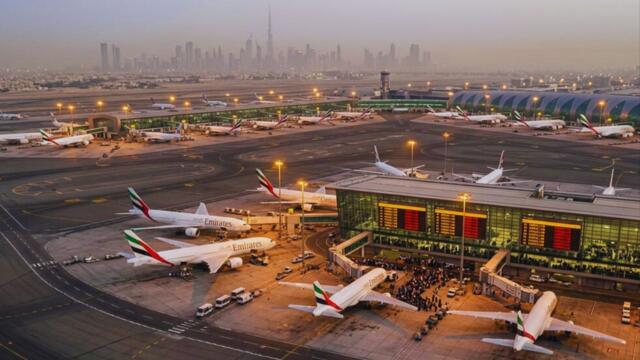
Beyond the Middle East itself, the effects quickly rippled outwards to global travel networks because the region serves as a central hub for long haul air traffic between Europe, Asia, Africa and the Americas. Airports such as Dubai International (DXB) and Doha’s Hamad International, which are among the world’s busiest transit hubs, suddenly became bottlenecks or dead ends for travellers, as flights could no longer connect through them safely without crossing closed or dangerous airspace.
By early March 2026, airline cancellations had spread far beyond regional carriers. International airlines, including British Airways, Lufthansa, Air France, Swiss International Air Lines, Finnair, and Air India, suspended flights to and from affected Middle Eastern destinations as airspace remained unsafe or closed, with many carriers offering refunds, rebooking options, or flight waivers for affected passengers. Some airlines suspended their entire route networks to the region, while others established temporary no-fly corridors and operated limited services under close regulatory oversight.
Thousands of travellers were stranded at major airports as airlines cancelled flights mid-week and governments scrambled to issue evacuation advisories and emergency travel guidelines.
Some regional carriers, such as Qatar Airways, began operating limited repatriation flights to help stranded passengers return home or reach safe destinations, carefully coordinating these operations with civil aviation authorities and military controllers to avoid conflict zones.
You can also read: Target Europe: Strategic Autonomy in an Era of Uncertainty
One of the most noticeable impacts has been on Asia–Europe flight routes. With the most direct corridors through the Middle East closed or restricted, airlines have had to reroute flights over more southerly or northerly paths, adding considerable flying time, fuel costs and logistical complexity to already challenging long-haul operations. This has materially increased airfares and put pressure on airline profitability as carriers adjust schedules and crew rotations to accommodate new routes. Passengers travelling between continents have seen ticket prices surge as a result. For instance, flights between Asia and Europe via rerouted paths now cost significantly more due to longer flight distances and higher fuel consumption — factors exacerbated by rising energy prices and geopolitical risk premiums. Load factors — the metric airlines use to measure how full a flight is — have also declined on many routes, as uncertainty discourages new bookings while travellers defer travel or cancel itineraries entirely.

The knock-on effects have extended into air cargo and global supply chains as well. Air freight capacity passing through Gulf market hubs has been suspended or reduced, affecting the timely movement of goods between Asia, Europe, Africa and the Americas. In some cases, cargo flights have been grounded or rerouted, slowing the delivery of high-value goods such as electronics and medical supplies at a time when supply chain resilience is already strained.
The conflict’s broader implications for global commerce and travel infrastructure cannot be overstated. Doha’s Hamad International — which saw millions of passengers transit in recent years — became a symbol of the disruption as its operations were severely curtailed during peak travel times. Even with partial reopening for repatriation flights, the airport’s connectivity remains constrained, signalling an uncertain recovery trajectory for Gulf hubs. Likewise, Dubai’s aviation ecosystem — previously touted as a global gateway — faced major setbacks as flights were cancelled or diverted to other continents, undermining its strategic role in global air travel.
The current situation has also revealed just how dependent regional economies are on stable air links. Airlines based in the Middle East rely heavily on transit passengers from Asia and Europe to sustain operations. With that network disrupted, carriers are operating at reduced capacity and facing revenue losses that industry analysts say could take months or even years to recover. Gulf nations, long focused on diversifying their economies through tourism and global business travel, now face the challenge of reassuring international travellers and rebuilding confidence amid lingering fears of instability.
You can also read:What if the Khamenei Regime Falls: Geopolitical Implications for the Region
The humanitarian side of aviation disruption must also be acknowledged. Thousands of travellers from Africa, Asia, Europe and North America found themselves stranded far from home when airspace closures began, prompting numerous governments to coordinate evacuation flights and assist citizens at foreign airports. In some cases, U.S. and European states organised charter flights to repatriate citizens, underscoring the urgent nature of the crisis. This chaotic period in aviation history illustrates how geopolitical instability can spill over into global connectivity, affecting not just passengers but also airlines, freight carriers, airports, and national economies. What began as a localised confrontation in the Middle East has become a catalyst for far-reaching air travel disruption, demonstrating that in an interconnected world, conflict anywhere can quickly translate into systemic challenges for global movement.
Disclaimer: The views expressed in this article are solely those of the author and do not necessarily reflect the official stance of The Himalayan Research Institute Pakistan (THRIP)
_________________________________
Waqas Abdullah is a geopolitical analyst and anthropologist with expertise in Middle Eastern and Indo-Pacific politics. A Türkiye Bursları Scholar, he is pursuing a Master’s in International Relations at Selçuk University, Konya, Türkiye. Director of Foreign Affairs at DAG Media Network. His work focuses on climate refugees, human security, and regional cooperation.
Contact us

Write with Us
The Himalayan Research Institute is proud to introduce "Himalayan," a dynamic and insightful magazin...
- [email protected]
- +923426470466
- website