
- Opinion Articles
- Undersea Reckoning: Pakistan's Hangor and the New Arabian Sea Balance
Undersea Reckoning: Pakistan's Hangor and the New Arabian Sea Balance

Irfan Farooq
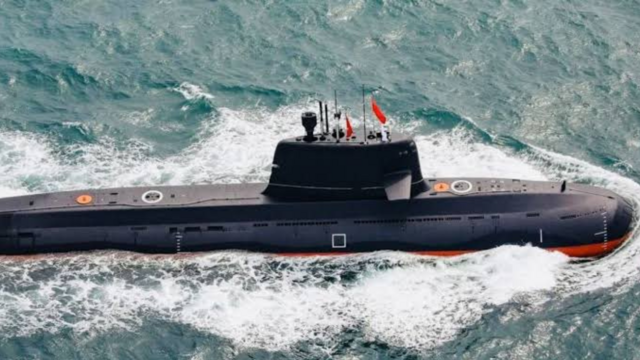
On April 30, 2026, Pakistani President Asif Ali Zardari commissioned PNS Hangor, the first of the eight advanced diesel-electric submarines, in the principal berth of the People's Liberation Army Navy in Sanya, China. The ceremony was done in a symbolic manner. The name Hangor has a history to it: the original PNS Hangor, a French-built Daphné-class submarine, sank the Indian frigate INS Khukri in December 1971, which was the first time that a submarine had sunk an Indian warship since the Second World War. Today, 55 years later, Pakistan's navy is not replacing a “gone with the wind fleet”. It is reclaiming undersea relevance in a maritime theatre that has grown dramatically more consequential.
In the past decade, Pakistan's submarine arm has been at a structural disadvantage for much of the time. Its existing fleet of two Agosta-70s and three Agosta-90s with Air-Independent Propulsion (AIP) systems has become increasingly outdated in the context of an Indian Navy that has grown faster than ever before. India's Kalvari-class submarines, the maritime patrol aircraft of its P-8I Poseidon, and its maturing undersea network of anti-submarine warfare (ASW) capabilities have collectively shattered Pakistan's undersea credibility in the Arabian Sea.
Also read: Deterrence & Cost of War: Strategic Significance of the MILGEM-Class Corvettes in Maritime Power
The Hangor-class directly addresses this gap. The Hangor is a Type 039A, an export variant of China's Yuan-class submarine, with an estimated displacement of 2,800 tons and AIP technology for extended underwater missions and greater range without surfacing. These platforms are equipped with heavyweight and anti-ship cruise missiles that can target surface warships, submarines, and shore-based targets, and represent a qualitative generational step ahead of any platform currently in Pakistan's inventory. The agreement, signed in 2015, is for the purchase of 8 boats worth $5 billion, 4 of which will be manufactured in China, and the remaining 4 will be produced at the Karachi Shipyard and Engineering Works under a technology transfer agreement. All four Chinese-built submarines were expected to undergo sea trials by early 2026 and would be commissioned in quick succession within the year.
Pakistan has never sought a blue-water navy. Its maritime doctrine has been influenced by a much more modest, but coherent, goal: minimum credible deterrence at sea. It's not about matching India's navy ship for ship, but about making Indian naval coercion too costly such that any opponent must take Pakistan's undersea capability into account when planning operations. According to this logic, the Hangor-class is not an offensive weapon; it is a cost-creating weapon.
An unmarked AIP-submarine in "littoral waters" in the North Arabian Sea is a basic challenge for Indian surface fleet planning. The mere presence of the submarine requires the Indian Navy to allocate resources to anti-submarine warfare, alter its patrol pattern, and adjust its assumptions regarding any possible blockade or maritime interdiction mission. This is what undersea deterrence is all about: Ambiguity is the weapon. The Hangor does not have to engage in a naval war to play its strategic role. It needs only to be that one must be unaffordable.
In traditional arms competition theory, military expansion is seen as intrinsically destabilizing. But in the Pakistan-India maritime reality, what has proven more perilous is the lack of balance, rather than balance itself. The war of 1971 illustrated the double-edged sword of naval superiority. India blocked off East Pakistan, and on the flip side, the conflict played out in ways that would have never been imagined had it not been for this superiority. Neither navy was oblivious to the lesson.
Also read: AUKUS and the Transformation of Australia’s Maritime Deterrence Strategy in the Indo-Pacific
This was further emphasised by the 2001 standoff after the attack on the Indian Parliament. While both sides prepared their forces on land and at sea, Pakistan had no credible maritime deterrence, which further narrowed its strategic options and heightened the risk of miscalculation. When a weaker party is unable to deter naval coercion with conventional methods, it may be forced to resort to asymmetric escalation or nuclear signalling – strategies that do not serve either side's interests, and which deterrence theorists from the right and left have consistently warned should be the most dangerous ones that could result from severe military imbalance.
Restoring a level playing field under the sea, paradoxically, eases these pressures on both sides. Pakistan will surely limit India's options in the Arabian Sea, especially when it can pose credible threats to India's surface forces, but this will also reduce the situations in which Pakistan might decide to go beyond conventional limits. The Hangor class is, in this respect, more of a case of a shift of advantage from one side to the other. It is a structural adjustment that increases the stability of deterrence for the region.
It is impossible to discuss Hangor without analysing it in the context of the China-Pakistan strategic partnership. China has been the major supplier of arms to Pakistan, with around eighty per cent of them provided between 2021 and 2025. The Hangor submarines are believed to be the biggest naval export sale in Chinese military history, as detailed in open-source reporting. It's not a coincidence; it's the benefit of a long-term partnership based on mutual strategic interests.
China's concerns here are not just related to Pakistan's security. The China-Pakistan Economic Corridor (CPEC) and the strategic port of Gwadar provide Beijing with important overland and maritime routes to the Arabian Sea, bypassing the vulnerability of the Strait of Malacca. The SLOC security is enhanced by a more capable Pakistan Navy in the North Arabian Sea and the Indian Ocean. This combines the legitimate national interests of two sovereign nations with compatible strategic objectives. The Hangor initiative is at the same time a Pakistani deterrence capability and a component of a regional maritime environment conducive to stable, secure access to vital waterways for both countries.
Commissioning of PNS Hangor is the starting point, not the end. At the end of the year, Pakistan's fleet of AIP-equipped submarines will have expanded to nearly double the current size from three Agosta-90Bs to up to seven boats, a record pace of growth in the Pakistan Navy's modern history. A further four submarines are yet to be constructed locally at Karachi Shipyard and will be delivered in the early 2030s. Under the umbrella of its Submarine Vision 2030, Pakistan's longer-term ambitions for a submarine with nuclear capabilities and its desire to become a submarine-designing nation are further down the road.
Hangor is not an instance of provocation. It is Pakistan's dilemma of building up its defense against a changing maritime threat environment in a hurry. The true challenge before us is not whether Pakistan can commission these submarines, which it has proved it can. The question for both Islamabad and New Delhi is whether they can now build their crisis communication systems, naval confidence-building measures, and strategic restraint to ensure that more capabilities on both sides at sea mean more stability, not more risk. There is no diplomacy without hardware.
Disclaimer: The views expressed in this article are solely those of the author and do not necessarily reflect the official stance of The Himalayan Research Institute Pakistan (THRIP)
_________________________________
Irfan Farooq is a Non-Resident Research Fellow at the Maritime Center of Excellence (MCE), Pakistan Navy War College, Lahore. His research primarily focuses on strategic studies, regional maritime dynamics, and emerging security challenges in the Indian Ocean region. He can be reached at: [email protected]
Contact us

Write with Us
The Himalayan Research Institute is proud to introduce "Himalayan," a dynamic and insightful magazin...
- [email protected]
- +923426470466
- website