
- Opinion Articles
- Political Mayhem in AJK: The Proscribed JAAC Movement and the Conundrum of Refugee Reserved Seats
Political Mayhem in AJK: The Proscribed JAAC Movement and the Conundrum of Refugee Reserved Seats
Alham Tariq
When the state labels a peaceful movement a proscribed movement, things start to go downhill. The tragedy is that history is filled with such lessons, but we’ve always turned a blind eye to them. AJK Elections are to be held on 27th July, and the government has designated the JAAC a proscribed organisation and is crushing the civilian protests.
Kashmir is the jugular vein of Pakistan; that slogan is outdated today. Azad Jammu & Kashmir (AJK) has been part of Pakistan for the past 78 years as a semi-autonomous, self-governing state, but is administered by the sovereign state of Pakistan. While it has its own Westminster-style parliamentary system with a President, Prime Minister, and a unicameral Legislative Assembly based in the capital, Muzaffarabad, it heavily relies on the federal capital of Pakistan, Islamabad, for many grants. Pakistan retains direct control over many key areas in AJK, including defence, foreign affairs, trade, currency, and security. With this context, it becomes easier to understand the ongoing crisis in Azad Kashmir.
The Joint Awami Action Committee (JAAC) movement began in 2024. It is, and has always been, a civil rights movement, and is strongly supported by the local populace. It is prudent to mention that JAAC is not a political organisation and has no political affiliation whatsoever with any mainstream political party. It is being led by a committee, with prominent members including Shaukat Nawaz Mir, Sardar Umar Nazir Kashmiri, Raja Ghulam Mujtaba, Imtiaz Aslam, and Hafeez Hamdani. The movement started as a protest against the inflated prices of Electricity and Wheat flour in Azad Kashmir. But the inflated prices were elsewhere as well, so why did the AJK populace start a protest? Azad Kashmir is a geographically rich region, with mountains, streams, and canals that flow naturally throughout. Mirpur, Azad Kashmir, is one such region. The Government of Pakistan started building Mangla Dam in Mirpur as part of the Indus Basin Project between 1961 and 1967, a 1000 MW Hydel Power Station. It provides 8% of Pakistan's total electricity.
Also Read: The Majority of GBs will vote for PTI in the upcoming Elections!
The JAAC protesters were of the view that electricity is being generated from their water in their region and is being provided to them at inflated prices. And alongside this, the wheat crisis affected the farmers first and later the consumers. The JAAC peaceful protests began in May 2024, and widespread strikes, sit-ins, shutdowns, and long marches were seen across AJK. It soon escalated into clashes with law enforcement agencies when they tried to crush these protests. The situation continued for six days, eventually prompting a temporary government agreement to provide subsidies.
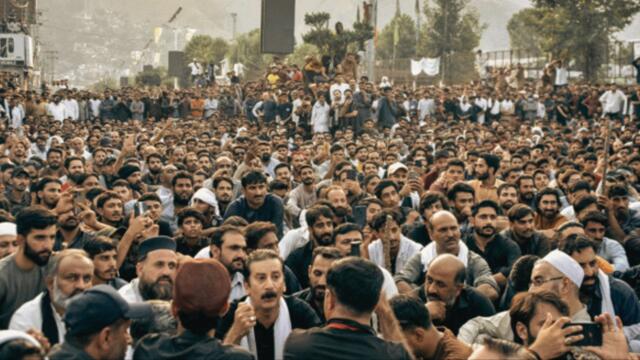
Driven by economic hardships, severe civic grievances and systemic political inequality, the JAAC again announced a region-wide protest in late September 2025. This time, their demands were clear. They presented a 38-point agenda, primarily focusing on reducing inflated electricity costs, lowering wheat flour prices, abolishing all luxury perks for AJK ministers and bureaucrats, advancing healthcare and development projects, and, most importantly, abolishing the 12 reserved seats for refugees in the AJK assembly. The peaceful protests were tried to stop and crushed by law enforcement agencies, the old rule book of any government. The situation escalated into deadly clashes between police and the protesters, causing both civilian and police casualties. Upon seeing this, the Federal Government sent a team of 11 negotiators to Muzaffarabad, and a marathon negotiation with JAAC began. Eventually, a breakthrough agreement was reached between the government and JAAC on October 4, 2025, and the government agreed to almost all the demands, including tariff reductions, financial compensation, development projects, the end of bureaucratic luxuries, and the abolishment of 12 reserved refugee seats.
Before proceeding, it is important to understand the issue of reserved refugee seats in AJK. The Legislative Assembly of AJK has 53 seats: 12 are reserved for refugees residing in Pakistan, 33 are general seats, and 8 are reserved for women, technocrats, the diaspora, and the ulama. A clear majority of 27 seats is required to form a government or pass any legislation. There are around 3.4 million registered voters in Azad Kashmir, and 33 constituencies. But it’s not the same for the refugee seats. There are no more than 490,000 registered migrant voters, and 12 seats. With around 50% voter turnout, a designated refugee candidate secures only a few thousand votes (usually less than 10,000) and a seat in the AJK parliament. The JAAC and a large populace of AJK view these seats as Trojan horses being operated by the Government of Pakistan to monopolise the legislation and politics in AJK. The MLAs on these refugee seats receive the same perks and privileges as others and secure the same development budget for their constituencies. The people of AJK view this as an exploitation of their resources. They are of the view that these refugees have been living in Pakistan for many decades, so they shouldn’t be considered refugees anymore, and hence their reserved quota must be removed from the legislative assembly and elsewhere.
JAAC issued an ultimatum to the government to fulfil the agreement, but the ultimatum was never implemented. Chaudhary Anwar ul Haq was the Prime Minister of AJK during these two protests. And after the October 4 agreement, pressure mounted on him, and he was ousted from office on November 17, 2025, following a successful no-confidence motion. In the aftermath of this, Raja Faisal Mumtaz Rathore, a PPP leader, became the Prime Minister of AJK.
Also read: Kashmiris’ right to self-determination: Role of India, Article 370, and its consequences
With the elections on the verge, on 28th July, and their demands, particularly the abolition of the reserved refugee seats, the JAAC announced region-wide protests, sit-ins, shutdowns, and long marches to be held on 9th June 2026. The Government of AJK held talks with the JAAC on 31st May, 2026, primarily to persuade them to call off the strikes, but the talks failed due to the JAAC’s insistence on ending the reserved refugee seats. The government claims that 90% of the previous demands were actively being addressed.
In the aftermath of this, on 04 June, the Government of AJK and the AJK Legislative Assembly strongly defended the status quo, backing the refugee seats and calling for elections to proceed on schedule. On 05 June 2025, the JAAC was designated a proscribed organisation and placed under the First Schedule of the region’s anti-terrorism act. The government advised tourists to leave the territory and called in Rangers, Frontier Corps (FC), and thousands of additional security personnel, citing the security risks in the region. This sparked region-wide protests, and law enforcement agencies are using every means to crush them.
The situation on the ground is bleak, with total mayhem. The government is applying coercive means to crush this movement, an old-school crisis management tactic, but this will keep building up the momentum. The state lacks a retrospective view of its policies and outcomes and is deemed to repeat them.
Disclaimer: The views expressed in this article are solely those of the author and do not necessarily reflect the official stance of The Himalayan Research Institute Pakistan (THRIP)
_________________________________
Alham Tariq is a poet, writer and political analyst from Pakistan. He is a Gold Medalist in BS International Relations from the University of Central Punjab, Lahore, and has a keen understanding of domestic and regional politics. His work primarily focuses on geopolitics, comparative governance and public policy.
Contact us

Write with Us
The Himalayan Research Institute is proud to introduce "Himalayan," a dynamic and insightful magazin...
- [email protected]
- +923426470466
- website