
- Opinion Articles
- Kashmiris’ right to self-determination: Role of India, Article 370, and its consequences
Kashmiris’ right to self-determination: Role of India, Article 370, and its consequences
Zaib Yaqoob Minhas
The Kashmir conflict originated in 1947, when the British Indian territory was partitioned into India and Pakistan. According to the partition plan, princely states could choose to join either country based on their geographical location and the will of their people. Kashmir, with its Muslim majority leadership, might have become part of Pakistan. However, under controversial circumstances, its Hindu ruler, Maharaja Hari Singh, signed an Instrument of Accession with India, leading to the first war between India and Pakistan.
India has roughly one million soldiers responsible for a population of nine million Kashmiris, making it one of the most heavily militarised regions in the world. It has also granted extensive powers to security forces through harsh laws, including the Armed Forces Special Powers Act (AFSPA) and the Public Safety Act (PSA), to sustain its occupation. These laws allow Indian troops to kill, maim, arrest, and charge Kashmiris without prior evidence or accountability. Widespread human rights abuses, including extrajudicial killings, enforced disappearances, and the torching of homes and businesses, have been common under the actions of Indian security forces. They have used excessive force, including pellet guns, which have blinded and maimed thousands of innocent Kashmiris, including children. Sexual violence has been employed as a means to humiliate and subdue the population, with reports of rape and other abuses by Indian forces.
Self-determination is a key principle in international law, and for the people of Kashmir, it remains an unfulfilled promise. The Kashmir issue is one of the longest-running conflicts in modern world history, continuing to be a persistent problem in South Asia. Although the United Nations Security Council (UNSC) has passed several resolutions affirming that Kashmiris have the right to decide their future, India has consistently refused to implement these resolutions, thus obstructing the self-determination process and prolonging the suffering of the people.
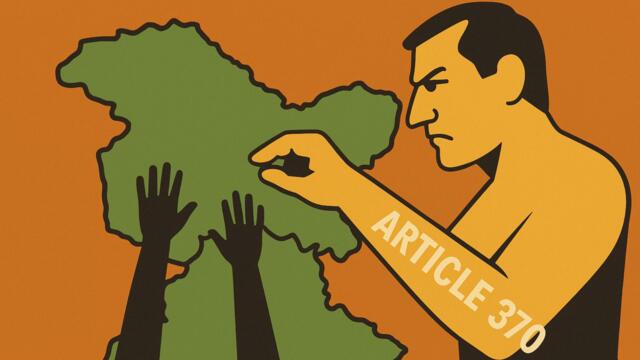
At the time of accession, a special provision was introduced into the Indian Constitution granting the state of Jammu and Kashmir special status and significant autonomy. Article 370 of the Constitution of India, enacted in 1950, addressed temporary, special, and transitional provisions for some states in the Union. 27 Provisions under this part of the Constitution allow a certain degree of self-governance, autonomy, and land rights. The Jammu and Kashmir constituent assembly was elected in 1951 and approved the abolition of the state’s monarchy.
Over time, Articles 370 and 35A became more divisive. Indian statemen, especially from Bharatiya Janata Party (BJP), were quite unhappy with the privileges granted to Jammu and Kashmir or the restrictions on permanent residents purchasing land. The Amarnath land transfer scandal in 2008 ignited fresh violence in a state already torn apart by years of strife. In May of the same year, the Indian National Congress government and the Jammu and Kashmir government reached an agreement, under which nearly 100 acres of forest land were allocated to the board of the Amarnath cave shrine, a primary Hindu site in the Vale of Kashmir and a centre for annual pilgrimages. This land was intended for temporary shelters and facilities for pilgrims. There was widespread outrage across the state, with leaders of separatist groups opposing the land allocation in a Muslim-majority area because it would change the population balance protected by Article 370. The Jammu and Kashmir government then reversed its decision and decided not to allocate the land. A new wave of protests erupted, this time by Hindu residents of the Jammu region. The Amarnath dispute continued to heighten tensions in Jammu and Kashmir. Over the following years, violence erupted sporadically, and the proposal to build a road to the shrine triggered further protests and environmental concerns.
Two months after Narendra Modi, the prime minister, and the BJP were re-elected to power on 6 August 2019, both houses of parliament passed a resolution abrogating Articles 370 and 35a. Article 370 ceased to operate, as declared by Indian President Ram Nath Kovind, except for a provision stating that all provisions of the Indian Constitution would apply to Jammu and Kashmir in full. One of the issues that led to the abrogation of Article 370 was the dissolution of the Jammu and Kashmir constituent assembly in 1957: Article 370 could not be amended in any way without the constituent assembly's consent. To circumvent this, on 5 August 2019, a presidential order was issued, redefining the term' constituent assembly' in Article 370 as 'legislative assembly'. Simultaneously, independent laws were passed, according to which the state was diminished and divided into the Jammu and Kashmir union territory and the Ladakh union territory.
The repeal of Article 370 was as controversial as its existence. The BJP government aimed to render the provision inoperative to fully integrate Jammu and Kashmir into India, address insurgency and separatism, and promote development. However, critics argued that the true motive was to alter the region's demographic makeup, which is predominantly Muslim. Removing the reference to the definition of permanent residents allowed all Indian citizens to buy land in Jammu and Kashmir, leading to an influx of non-Kashmiri populations into the union territory and enabling more Hindus to relocate there from Muslim-majority areas. The move was also criticised for the way the abrogation was carried out and for stripping Jammu and Kashmir of its statehood.
During the months that followed, it filed several petitions in the Supreme Court attempting to challenge the constitutionality of the abrogation of Article 370. The case was referred to a constitutional bench, a panel of five or more judges that issues rulings based on interpretations of the Constitution. The Supreme Court upheld the repeal in 2023, stating that Jammu and Kashmir's internal sovereignty was no different from that of other states in India and that the government was not exceeding its powers in repudiating a provision that was neither permanent nor everlasting.
To oppress the people of Kashmir, India has employed excessive military force, widespread atrocities, and brutality for over 70 years. It has worked tirelessly, but it has not been able to alter their objectives or crush their spirit. The Kashmiri people's resilience remains unwavering, and they continue to demand their own nation. Indian officials must adopt a rational and practical approach, abandoning repressive tactics that only increase hostility and prolong the conflict. Recognising the Kashmiri people's right to self-determination is essential for finding a fair and lasting solution. Doing so would benefit Kashmir, regional stability, and India's future, helping to achieve a peaceful resolution as swiftly as possible.
Disclaimer: The views expressed in this article are solely those of the author and do not necessarily reflect the official stance of The Himalayan Research Institute Pakistan - (THRIP)
_________________________________

Zaib Yaqoob Minhas is a researcher and a final-year Public Administration student at Riphah International University, Pakistan. Her research focuses on human rights violations, social issues, global affairs, and governance, with practical experience in policy research, policy analysis and academic writing.
Contact us

Write with Us
The Himalayan Research Institute is proud to introduce "Himalayan," a dynamic and insightful magazin...
- [email protected]
- +923426470466
- website