
- Opinion Articles
- Deterrence Without Nuclear Weapons
Deterrence Without Nuclear Weapons

Hassan Raza
In December 1941, Imperial Japan appeared unstoppable. It had taken over the Hong Kong colony, the French Indochina region, and even the U.S. territory of Guam. The attack on Pearl Harbor became highly significant due to three reasons: (a) it transformed an Eastern regional theater into a global war by bringing the Western Hemisphere into the conflict, (b) it shattered the geographical invincibility of the United States from foreign military invasions, and (c) it forced the United States to respond to Japan by adopting an "island-hopping strategy" in East Asia. This strategy resulted in devastating naval defeats, economic strangulation, and strategic bombings in Japan. Yet, the U.S. was unable to influence Japan. It ultimately took the atomic bombings of Hiroshima and Nagasaki to compel Tokyo’s capitulation, forever embedding nuclear weapons into the vocabulary of deterrence.
Evolution of Deterrence:
At the start of the Cold War, deterrence became synonymous with nuclear weapons, as they served as an instrument to deter both opposing ideological camps with unprecedented, unpredictable, and unacceptable costs for a state. Meanwhile, states utilized international treaties like the Non-Proliferation Treaty (NPT) and the Anti-Ballistic Missile (ABM) Treaty to halt the vertical and horizontal spread of nuclear weapons in tandem with refraining superpowers from developing anti-ballistic missile systems. Thus, these measures limited the monopoly of ultimate deterrence to a specific number of states in the global arena.
Also read: The Diplomatic Failure: When Words Die, Wars Begin
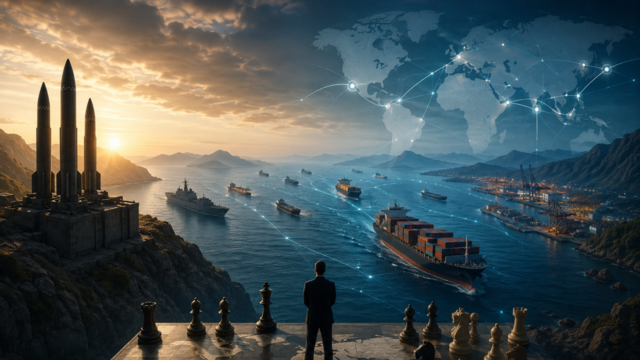
In response, it incentivised middle powers like Iran and Egypt to develop their own weapons for deterrence by exercising coercive power through a different instrument. This is where geography came into play. Control over maritime chokepoints, hedging through strategic elements, and disruption of energy flow. In the contemporary globalised world, where 80% of global trade is conducted by sea. Middle powers utilize their geography and translate it into a weapon of last resort. They have gained the ability to disrupt global commerce. It can generate strategic leverage rivalling that of military force and allowing even non-nuclear states to influence the calculations of far stronger states.
Sir Walter Raleigh once famously argued that commanding the sea ultimately meant commanding global wealth; Alfred Thayer Mahan argued that maritime dominance was the foundation of national power. In the early 1940s, Nicholas Spykman similarly asserted that the struggle for strategic geography determines political influence in his famous ‘Rimland Theory ‘. Their contributions remarkably explain contemporary geopolitical developments. Rather than initiating a total war, contemporary states compete to shape the global arteries through which international trade flows. Whichever state controls these trade routes possesses leverage that extends far beyond its military strength. Giving a strategic advantage at the negotiating table.
Deterrence through Control:
Strategic chokepoints such as the Strait of Hormuz, the Suez Canal, and the Strait of Malacca are prime examples. These narrow lanes are not merely shipping lanes. Rather, they are economic pressure points through which an entire region exports their products. Their disruption or closure instantly sends shockwaves through global supply chains. It increases insurance premiums, energy prices automatically rise for the common man, and it compels governments thousands of miles away to open the chokepoint. Unlike a nuclear weapon state, whose interests largely align with preventing war by ensuring credible deterrence, maritime chokepoints exert pressure without force. It basically holds another state's exports/imports hostage and compels regional states to resolve the issue rather than become parties to it.
American economist Thomas Schelling calls deterrence "the power to hurt”. Coercion in international relations does not necessarily require military force. It demands the ability to impose unacceptable costs for adversaries. Maritime chokepoints reflect this principle. The possibility of disruption can alter diplomatic calculations because uncertainty itself carries financial consequences for an entire region and, to a certain extent, the whole world. Investors hate uncertainty and quickly divest their investments, shipping companies reroute vessels to longer routes, and tourism-reliant states also face the burden. Economic vulnerability through maritime checkpoints is a powerful tool of strategic deterrence.
Iran is the best example. Despite lacking an adequate air force and blue-water navy, it has managed to disrupt one of the world's important maritime oil transit corridors. It has disrupted one of the world’s important maritime oil transit corridors. Iran utilized comparatively cheap missiles, drones and sea mines to disturb and control the Strait of Hormuz. International shipping companies diverted vessels around the Cape of Good Hope, adding weeks to transit times and incurring billions of dollars in additional transportation costs for Global South nations such as India. The consequences were hardest on regional states like Pakistan, but European manufacturers, Asian exporters, and global oil prices also rose quickly. A comparatively weaker state successfully imposed strategic costs on much stronger adversaries by exploiting geographic dependence rather than military superiority.
Recent conflicts explain that nuclear weapons still remain the ultimate guarantee against existential threats, but they are politically unusable. In contrast, maritime chokepoints operate within a grey zone. They allow states to impose costs, signal resolve, and influence adversaries without crossing the nuclear threshold. This explains why even nuclear-armed powers devote enormous resources to protecting sea lanes by expanding naval capabilities and presence. The Ottoman Empire once disrupted European trade through the Mediterranean Sea; Britain controlled the Strait of Hormuz and the Suez Canal during the ‘Great Game’; and, in contemporary times, U.S. leadership has exerted pressure to regain control of the Panama Canal to counter growing Chinese influence.
Also read: Geopolitics of the Red Sea: How Somali-land Reshaped Regional Alignments
States like China have sought to address challenges to maritime trade routes by introducing the Belt and Road Initiative (BRI). It connects continents via land routes and bypasses maritime chokepoints by investing in ports such as Gwadar. Nevertheless, sea trade remains dominant, but its instability has created a deterrent model for non-nuclear states.
Conclusion:
In conclusion, the future of deterrence will not be determined exclusively by the number of nuclear warheads. It will also depend upon control over the world's maritime shipping lanes. In a globalized economy, disrupting trade can be as consequential as deploying military force. The great strategic competition of the twenty-first century is therefore not merely a contest of kinetic strength. It is equally a contest over ports, sea lanes, and chokepoints. Nuclear weapons may prevent total war, but strategic waterways (chokepoints) determine who possesses influence in times of peace. Geography, once regarded as a prison for a state, has become a tool for deterrence.
Disclaimer: The views expressed in this article are solely those of the author and do not necessarily reflect the official stance of The Himalayan Research Institute Pakistan (THRIP)
_________________________________
Hassan Raza is a scholar of international relations currently studying at the University of Central Punjab, Lahore, Pakistan. His research interests are geopolitics, history and political science.
Contact us

Write with Us
The Himalayan Research Institute is proud to introduce "Himalayan," a dynamic and insightful magazin...
- [email protected]
- +923426470466
- website