
- Opinion Articles
- We are not the Chosen Ones!
We are not the Chosen Ones!

Wajeeh Ullah
Remember when Carl Sagan called us, the humans, wanderers and explorers in the cosmos. He was undoubtedly right about it. Humans have wandered around the globe for hundreds of thousands of years. This wandering has profoundly shaped their cultural ideas, languages, group affiliations, and, most importantly, their lineage. Today, all humans belong to the species Homo Sapiens. But we cannot forget our nearest cousin, the Neandertals, who lived and survived the ice ages for almost 350,000 years. The extinction of Neandertals was purely a biological phenomenon, but this raises many philosophical questions about our own existence and challenges the notions of pride and superiority that have been taught by various religious and societal traditions. Critical thinkers can relate the extinction of Neandertals to the opening of Pandora's box about our own existential future.
Homo sapiens first appeared in Africa approximately 300,000 years ago. We were not impressive creatures initially. We were weaker than most predators surrounding us, less likely to survive harsh natural conditions, and physically unremarkable. Yet we developed specialised biological and social adaptations that helped us survive for generations. For most of our early existence, we remained in Africa, gradually adapting to different environments across the continent. We hunted large animals, gathered plants, made tools, and gradually formed larger social groups.
Meanwhile, across Europe and parts of western Asia, another human species, the Neanderthals, was already well established. They had lived in these regions for over 300,000 years, adapting perfectly to the harsh Ice Age climate. Neanderthals were impressively strong, with powerful muscles and stocky bodies designed for survival in cold environments. They had larger brains than we do, around 1,500 cubic centimetres, compared to our 1,350. They were surely not the weakest link in human evolution. Neanderthals controlled fire expertly, made sophisticated stone tools, hunted large mammals, and took good care of their elderly and sick. They even possessed mortuary behaviours, which means they carried out burials of their dead.
Then, around 50,000 to 60,000 years ago, abrupt changes were seen. Groups of Homo sapiens began leaving Africa (remember the wanderers) in waves of migration. Some travelled to the Middle East, others to Europe, and to Asia’s far east. When Homo sapiens finally encountered Neanderthals in Southern Europe and Western Eurasia, the outcome was not simple warfare or instant replacement. Instead, we interbred. Today, it is said that people of European and West Eurasian descent have 1-4% of Neanderthal DNA.
However, around 40,000 years ago, the Neanderthals disappeared. Their populations declined sharply, and they went extinct.
The question of why we survived while they did not can be answered in three ways. Understanding this difference requires examining three dimensions: physiology, brain organisation, and social structure.
Physical Differences
Neanderthals were constructed as wrestlers. They were approximately 168 centimetres tall and had unusual muscle mass and strength. Their bodies were short and intense, and their noses long and high. Their physiology was fully developed to survive in the Ice Age. Physical combat would give a Neanderthal a near-guaranteed victory over a modern human.
Homo sapiens were taller and much weaker. We were smaller-faced, greater foreheaded, weaker chinned, more like exposed skeletons. We seemed physically inferior. But this weakness eventually turned to our advantage.
Brain Organization
Neanderthals had larger, elongated brains. Their brains were set up differently, as recent studies have shown. Neanderthals invested a lot more energy in vision and observation because of their evolutionary behaviour.
Whereas Homo sapiens' brain evolved differently. Their brains were smaller and rounded. They were designed more to develop language, social skills, and abstract thoughts. The Homo sapiens brain had a large cerebellum and parietal lobes.
Social Organization
This difference was the most essential one. Neanderthals were hunter-gatherers who lived in small, isolated groups of 10-30 people. Even across Europe and Asia, there were only 5,000 to 70,000 people. These intimate societies had strong bonds and tight family units. But their external social contact was minimal.
Homo sapiens were opposite. We formed larger groups and had a vast web of contacts across them. We exchanged products, knowledge, and genes across populations. If one group of people developed an improved hunting method, the news spread to other societies. In times when parts of the world were no longer livable due to climate change, we could move to neighbouring areas. We were networked in a manner that was the polar opposite of Neanderthal.
Nature has a systematised working course. Those who are ill-suited to current natural conditions gradually disappear. Small groups of people are vulnerable to extinction. They are more prone to be killed by disease, starvation, or severe winters. In prehistoric times, smaller groups were the most vulnerable; they were continually threatened by wild animals and by rival large, powerful groups. The division of Neanderthal groups was their greatest weakness. When 20 people and their band had died, there were not enough immediate neighbours to resettle the territory and increase the population deficit. These local extinctions accumulated over thousands of years.
Secondly, upon the migration of homo sapiens into the Neanderthal lands, competition over the resources increased. They competed over caves, hunting grounds, animals, and water. In these fights, Homo Sapiens were more likely to prevail because of the experiences and skills they had acquired through continuous migrations. Furthermore, they must have outnumbered the Neandertals in many feuds.
Thirdly, the most recent scientific theory is that Neanderthals were not killed but assimilated. Since Homo sapiens interbred with Neanderthals and our population was extremely large, Neanderthal genes slowly diluted into the human gene pool. Over 10,000 to 30,000 years, different Neanderthal groups disappeared as Homo sapiens increased in number. They vanished as individuals, leaving behind their genetic heritage.
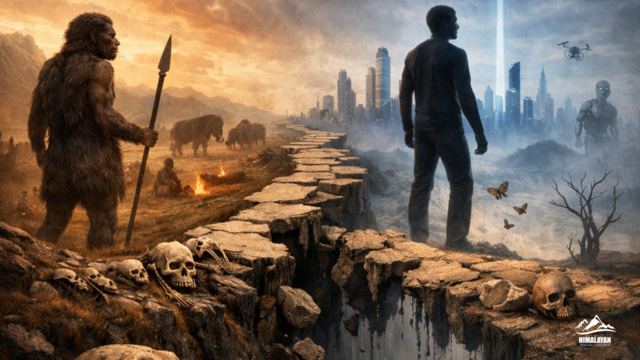
The story of Human evolution doesn’t end here. Today, in 2026, we are undergoing another transformative change whose effects will be evident over the next hundred years. Most importantly, it will no longer take hundreds of thousands of years for evolution to produce a new species. Human-crafted superintelligence is driving this evolution at an unmatched pace, unlike the steady, slow progression characteristic of nature.
In the next 100 years, we will face the same existential threat as Neanderthals did 40,000 years ago. But this time, we would be aware of the trajectory of change. In subsequent centuries, we can imagine the mingling of Homo sapiens and superintelligent beings, resulting in a cyborg. This is a change no one can stop, not even by the beliefs that elevated us to the status of a messenger of God and brought so-called true meaning to our lives.
The Neanderthal story teaches a harsh lesson. No species, no matter how intelligent or established, survives forever. Neanderthals thrived for 300,000 years. We have been alone for only 40,000 years. Our reign might be shorter. We are not the end point of evolution or intelligence. We are simply a stepping stone. The "chosen ones" narrative is a comforting myth, not truth. The future belongs not to those deemed superior, but to those who adapt best to the challenges ahead. We survived not because we deserved to. We survived because of luck, timing, and features that happened to work well in one moment in Earth's history. That should make us humble, not arrogant. That should make us careful about the future we create. And that should make us wonder: If a species as capable as Neanderthals could vanish, what makes us think we are safe?
Disclaimer: The views expressed in this article are solely those of the author and do not necessarily reflect the official stance of The Himalayan Research Institute Pakistan (THRIP)
_________________________________
Wajeeh Ullah is a BS Political Science student at Government College University Lahore, Pakistan.
Contact us

Write with Us
The Himalayan Research Institute is proud to introduce "Himalayan," a dynamic and insightful magazin...
- [email protected]
- +923426470466
- website