
- Blogs
- South Korea’s Dilemma
South Korea’s Dilemma

Wajeeh Ullah
After the 2024 December temporary martial law, much changed in South Korea. A new democratic government was reinstated, meaning that political resistance changed, the social contract was revived, and most importantly, put women in the forefront of the highly rigid patriarchal society of South Korea. All this counts in the long term for South Korea's bright future. The only exception is that, by the end of this century, South Korea will have the highest proportion of its population aged 65 or older. The worst-case scenario is that half of the participants will be women.
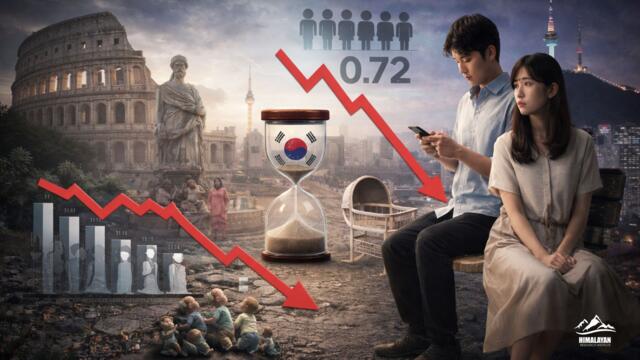
Elon Musk once wrote on the social media platform X that Rome fell because the Romans stopped making Romans. The understanding is the same for the East Asian nation of South Korea. The country has the lowest average fertility rate in the world despite its economic stability, modern society, and resourcefulness. To understand this phenomenon, we must first understand how the total fertility rate is calculated. Here, the average is calculated as the number of children a woman reproduces during her fertile period, from age 15 to 49. In South Korea, it is the lowest, at 0.75, according to published data. The average TFR (Total Fertility Rate) that indicates a healthy reproduction cycle in a country is 2.1. This means that if a woman has fewer than two children during her fertile reproductive years, there is a greater risk of an ageing population. If a country has a TFR below 2.1, it also disrupts its replacement cycle. Replacement cycle refers to the emergence of a new generation as the preceding generation enters adulthood.
According to various media reports, South Korea's TFR in 2023 was 0.72, and the annual birth population was 230,000, which indicates a 7.7% decline from the previous year. In 2024, the total fertility rate increased to 0.72%, and the annual birth rate reached 238,000, a slight increase from previous years. However, this was not always the case. According to OECD data, South Korea's total fertility rate was six births per woman in 1960. It gradually declined to 1 child per woman in the year 201. Another PMC study shows that between 1960 and 2024, the South Korean population doubled, alongside an ageing population. The same data source shows that the median age, which was 19 in the 1960s, reached 44.5 in 2023, indicating a substantial increase in the share of the population aged 44.5 and older relative to the total population. The South Korean government is optimistic that it will achieve the 1-child-per-woman threshold by 20230. They have pitched it as their top priority, but it is hard to find how they will achieve it by carrot or by stick.
South Korea is the world's 12th-largest economy. They have proven to be leaders in cross-cultural entertainment and cutting-edge technology, yet their social fabric remains highly polarised. South Korea has become a vibrant society, but this was not always the case. The low fertility rate has deep historical linkages to societal norms and teachings. Most South Koreans follow Confucian teachings. They undoubtedly confer depth and satisfaction but also undermine a woman's individuality and personal freedom, which are hallmarks of the modern industrial era. The three confusion obedience teachings for women were;
· One should obey one's father before marriage
· One should follow their husband after marriage
· One should be bound to her son after becoming a widow.
All these teachings have unforeseen impacts on their followers.
Many researchers have studied these low fertility rates and drawn meaningful conclusions. Erin Hye-Won Kin observes in her research article “Division of domestic labour and lowest-low fertility in South Korea published by the Demographic Research in 2017, that married women face persistent gender inequality in South Korea's patriarchal society. They must act as both a mother and a professional simultaneously. Husbands do not help with daily chores and are indifferent to household activities. Childcare centres are expensive and unaffordable for the average South Korean. Another stigma that has remained persistent in the South Korean society is that of male child births. This is the heritage embodied in the traditions' confusing teachings. All this has led to a systematic belief system that led women to refuse to give birth, as it has undermined their personal potential in the past. It shows that collective memories are hardwired into social systems and offer profound lessons.
This stagnant fertility rate carries many complications for the South Korean society. South Korea’s population will age over the next 60 years. Its adult workforce will decline sharply, slowing its economic growth. The South Korean economy could reach a low point due to a shrinking workforce and fewer taxpayers. The natural flow of modern ideas will be impeded, as no one will be there to receive and understand them. An ageing population will result in a society with a conservative approach and traditional business practices. It will affect politics, which is already highly polarised, further exacerbating the situation. All these impacts can worsen over time, giving rise to additional problems.
Additionally, Societies have a persistent tendency to change. They faced challenges and overcame them when the situation arose. It is usually achieved through chaos, agitation, and changes in the political landscape. The change is carried out by the ones who have remained oppressed. In South Korea's context, women have retaliated against the outdated, rotten patriarchal culture with all their might. They actively engage in national politics and hold personalised opinions. All this retaliation has led some feminist factions to preach and follow the hardcore 4B movement. The founders agitate and raise slogans such as "Bihon," "Bichulsan," "Biyeonae," and "Bisekseu." These Korean words, which make the 4Bs, refer to no heterosexual marriage, no childbirth, no dating men, and no heterosexual sex. They face strong resistance from the conservative right but have attracted significant attention among adults, particularly young adults born in the early 2000s. Everyone has the fundamental right to freedom of speech, expression, and assembly; however, at this time, these movements could undermine the government's efforts to increase fertility rates.
To conclude, South Korea can expect a bright future only if its workforce is youthful, skilled, and adaptable to modern change. No modern nation can sustain its future without channelising the potential of its youth, managing a steady birth rate, and including women in the progression. In South Korea, rigorous measures must be implemented soon.
Disclaimer: The views expressed in this article are solely those of the author and do not necessarily reflect the official stance of The Himalayan Research Institute Pakistan (THRIP)
_________________________________
Wajeeh Ullah is a BS Political Science student at Government College University Lahore, Pakistan.
Contact us

Write with Us
The Himalayan Research Institute is proud to introduce "Himalayan," a dynamic and insightful magazin...
- [email protected]
- +923426470466
- website