
- Blogs
- Gilgit-Baltistan (GB), Beyond Camera’s Lens
Gilgit-Baltistan (GB), Beyond Camera’s Lens
Areesha Rauf
I belong to Gilgit-Baltistan (GB), located in northern Pakistan, commonly known as the Northern Areas. It shares its borders with China. It brings economic and industrial stability to Pakistan with each dig in the chest of its mighty mountains. GB is enriched with colours and shades. It's the land of colours, decorating its face with warm and cool hues with every passing year. The land is dotted with lush green fields, yellow-orange fruits, White, sparkling trees, and long, veiny stems.
This mesmerizing land is augmented with its diverse culture, content with love and endless beauty. Here, every language has numerous dialects, and culture is embedded in its roots. The beauty holders have a way more graceful heart and a kind nature. They're renowned for their love, care, and hospitality. The sacrifices and devotion made by the ancestors of these mountains still echo in the dales and flow with the rivers.
Gilgit Baltistan, shown on postcards, Instagram posts, Facebook reels, and TV channels, has a backstory that the camera's unreal eyes can never capture. The aesthetic pictures are attractive only to viewers.
The lives of people living here are miserably beautiful. Neither any technological means nor any words can describe the pain of the natives.
I know my words can never fully capture the suffering the way it truly exists. Still, it's my humble attempt to portray the reality behind a beautiful post on the internet that shows a magnificent, glaciated mountain in the background, with two kids standing in front of a destructive building filled with rubble from the ceiling. The cracked walls were there, half-fallen and half-standing. The ground was filled with grass and wildflowers. The sun's rays were dancing like a peacock’s wings, showing the dark and light shades of its feathers, casting shadows all over the grassy earth. The little boy and girl with brown and hazel eyes and pinkish cheeks were grinning, looking into the camera's unreal eye. The post had a caption that read, “The Land of endless charisma, Gilgit Baltistan.” Having more than 200k likes and comments, it was one of the trending posts on the internet.
When the real eye peeks through the screen a bit more closely, it discovers the harsh reality checks that the post didn't highlight.
The 10-year-old Shahmir, with his brown eyes matched with his curly hair, wearing an oversized kameez and a mismatched shalwar. He was with his 12-year-old sister, Samina Bibi, wandering there to pick sticks for cooking fuel. She was wearing untidy clothes, torn slippers and an overly long dupatta, from which her oily, dusty bangs were slipping onto her dry, patchy face. She was smiling, her lips hyperpigmented and her hazel eyes where coffins of various unreachable dreams were buried. They were standing in front of the only primary school in the village.
The school was constructed two years ago and was demolished after one and a half years by an earthquake. The number of students might be 40 to 50 at the primary level. There was no other school in their area. Now, Shahmir and Samina Bibi had got a new job: to carry tourists' luggage to their camps and serve as unpaid characters in their photographs.
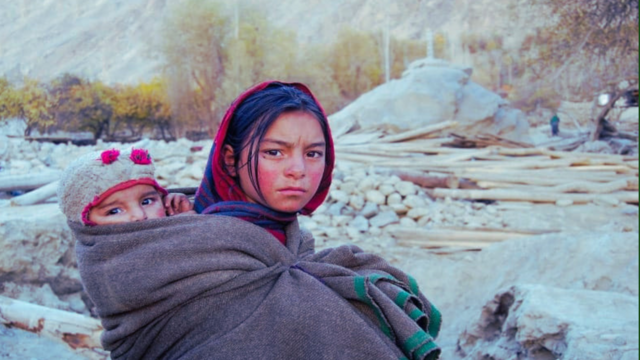
This was a glimpse of a single picture being shown on social media. Whether the reality holds bigger truths and antagonists. The educational centers are far from sufficient in the rural areas of Gilgit Baltistan.
According to the Government of Gilgit Baltistan Multiple Indicator Cluster survey (2016-2017), the literacy rate among children at the primary level is about 49%, while the overall literacy figure is 53%, according to the Planning and Development Department, Government of Gilgit Baltistan.
The rate of uneducated underage children increases the child labor graph every day. Those children help their parents earn a living at an age when they're not even supposed to know the source of it. The colours of beauty bring tranquillity to the visitors, but each scenery poses an obstacle for the indigenous people. They fight health issues more than financial issues. All 14 districts have barely one, or in some cases two, hospitals to treat patients. While the tehsils have scarcely any dispensary.
At a time when diseases have become part of the air humans inhale. People of GB have dispensaries at the cost of their health security. Basic human necessities such as water, electricity, and transportation facilities are limited. Women's empowerment is at its lowest level. The backward Orthodox males make it more complicated. No Girls’ colleges can be found in many of the villages. The schools are only up to primary level or secondary level, which makes no difference at all.
Gilgit Baltistan is undoubtedly a breathtakingly beautiful part of Pakistan, but why are the poor treasure-holders being overlooked? As illusion and radiance are seen, but reality and darkness are hated. Just like that, GB is being seen, but people are left unseen.
The setbacks need to be lightened, addressed, and rectified; otherwise, it makes the heavenly-looking GB seem uglier because of the veiled and bleak reality, which makes people feel ashamed of being seen and looked after.
The shrouded health and educational conditions of this area need attention and love, as the enchanting views do.
Disclaimer: The views expressed in this article are solely those of the author and do not necessarily reflect the official stance of The Himalayan Research Institute Pakistan (THRIP)
_________________________________
Areesha Rauf is a resident of Gilgit Baltistan. She can be reached at [email protected]
Contact us

Write with Us
The Himalayan Research Institute is proud to introduce "Himalayan," a dynamic and insightful magazin...
- [email protected]
- +923426470466
- website