
- Opinion Articles
- From Makkah Joint Defense Agreement to a New Muslim Security Architecture: What Bangladesh’s Potential Entry Could Mean for Pakistan
From Makkah Joint Defense Agreement to a New Muslim Security Architecture: What Bangladesh’s Potential Entry Could Mean for Pakistan

Waqas Abdullah
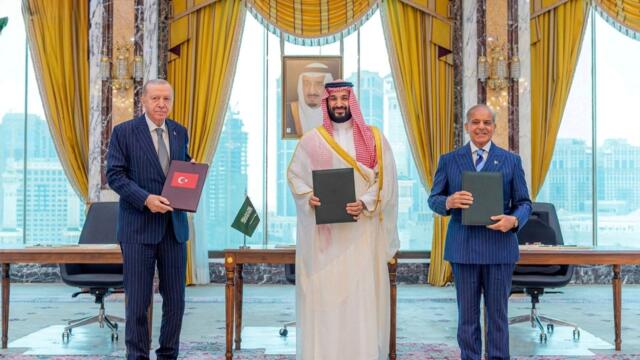
The foreign policy of Pakistan is seemingly going through a new and more strategic episode. Islamabad's foreign policy for decades has been viewed largely in terms of its partnership with China, relationship with the United States, rivalry with India, and security concerns on its western frontiers. But in the geopolitical climate of 2026, Pakistan is keen on diversifying its strategic partners and is looking to expand its foreign policy agendas. One of the most obvious examples of this new method is the Joint Defense Agreement signed by Pakistan, Saudi Arabia, and Türkiye in Makkah on 7 August 2026. The agreement states that an armed attack on one of the three states would be considered an attack on all three, and the governments have made a point of emphasizing the defensive nature of the agreement.
The Makkah Agreement has more than just been a defense pact. It provides Pakistan with significant military power, nuclear capability, strategic geography, and years of experience in managing security in the region, Saudi Arabia with economic power, energy resources, and a central role in the region's security affairs, and Türkiye with a strong conventional military force, a rapidly growing defense industry, and geographical access to Europe, the Middle East, the Black Sea, and Eurasia. This partnership thus forms a strategic triangle between South Asia, the Gulf, and Eurasia. This cooperation can be expanded to form a broader security system between the Muslim-majority countries in the future.
This is more important for Pakistan because of its potential to be part of the Makkah framework. Bangladesh's Foreign Minister Khalilur Rahman, on 27 August, said Dhaka will consider positive steps to accede to the pact if the founding members formally extend the invitation to Bangladesh. Officials in Bangladesh have also said they are continuing talks about possibly joining, but that hasn't been officially stated.
Bangladesh's accession would add a new and significant South Asian dimension to the Makkah security package for Pakistan. The current situation links Pakistan to the Gulf via Saudi Arabia and Eurasia and the Middle East via Türkiye. Bangladesh would expand this strategic geography further east towards the Bay of Bengal and the Indian Ocean. As a result, Pakistan may play an important role as a link between the west and east of an emerging Muslim security network.
The geopolitical significance of Bangladesh should thus not be underestimated. Dhaka is strategically placed on the edge of the Bay of Bengal, has a large population, a sizeable military force, and is becoming an important economic power in South Asia. Participation would provide a maritime dimension to the Makkah framework and opportunities for cooperation in naval security, disaster response, counterterrorism, defense training, and intelligence sharing. This may also mark a new era in Pakistan-Bangladesh relations for Islamabad, which could engage in the relationship at a broader multilateral level instead of exclusively through the historical and bilateral prism.
The possibility of Bangladesh's inclusion could also give a boost to Pakistan's diplomatic stature in South Asia. Pakistan has always had an issue with the keeping of strategic space in a region which is dominated by India in terms of economy and military. Bangladesh could enter into a security pact along with Pakistan, Saudi Arabia, and Türkiye, thereby bringing Islamabad's diplomatic ties with Dhaka to a new level of strategic weight. But it is important that Pakistan does not make the development look like it is an anti-India move. The Makkah Agreement is said by members to be defensive and will need to be judged to some extent on its ability to remain defensive.
For Pakistan, the success of the Makkah Agreement should not be measured simply by the number of Muslim-majority countries that join it, but by the tangible strategic and economic benefits it generates. Symbolic diplomatic declarations cannot establish a sustainable security framework. Instead, the agreement's long-term value will depend on practical cooperation in defense production, technology transfer, military training, intelligence sharing, maritime security, investment, trade, and industrial development. These areas can transform political commitments into meaningful strategic partnerships.
In this context, Bangladesh's potential entry into the framework could become an important test of Pakistan's strategic diplomacy. If Dhaka eventually joins, Islamabad should look beyond traditional defence cooperation and pursue broader economic, maritime, technological, and diplomatic connectivity. Greater engagement with Bangladesh could strengthen Pakistan's presence in the Bay of Bengal while avoiding the perception that the relationship is designed as an anti-India alignment. Such an approach would allow Pakistan to expand its regional role through cooperation rather than confrontation.
The emerging defence partnership also reflects a possible diversification of Pakistan's foreign policy. Islamabad can maintain its longstanding strategic relationship with China while simultaneously strengthening engagement with the United States, Gulf countries, Türkiye, Central Asia, and other Muslim-majority states. The objective should not be to replace one strategic dependency with another, but to develop multiple diplomatic, economic, and security alternatives that provide Pakistan with greater freedom of manoeuvre in an increasingly competitive international system.
Ultimately, the effectiveness of the Makkah Agreement will depend on Pakistan's ability to institutionalize these partnerships through investment, technological cooperation, trade, industrial development, and sustained diplomatic engagement. If Bangladesh and other strategically significant Muslim-majority countries become part of this framework, Pakistan could contribute to a broader security network connecting South Asia, the Gulf, and the wider Muslim world. The agreement could therefore represent an initial step toward a more diversified, proactive, and economically grounded foreign policy.
For Pakistan, the success of the Makkah Agreement should not be measured by the number of Muslim-majority countries that join it, but by the tangible strategic and economic benefits it generates. Beyond symbolic diplomatic commitments, cooperation in defense production, technology transfer, military training, intelligence sharing, maritime security, investment, and trade would provide a stronger foundation for a sustainable strategic partnership.
In this context, Bangladesh's potential entry could serve as an important test of Pakistan's strategic diplomacy. If Dhaka joins the framework, Islamabad should look beyond defense cooperation and promote economic, maritime, technological, and diplomatic connectivity. Such engagement could strengthen Pakistan's presence in the Bay of Bengal while avoiding the perception of an anti-India alignment.
The emerging defense partnership also reflects a broader diversification of Pakistan's foreign policy. Islamabad can maintain its longstanding strategic relationship with China while strengthening ties with the United States, Gulf states, Türkiye, Central Asia, and other Muslim-majority countries. This approach would create multiple diplomatic and economic alternatives rather than replacing one strategic dependency with another.
Ultimately, the Makkah Agreement's success will depend on Pakistan's ability to institutionalize these partnerships through investment, technology, trade, industrial development, and diplomatic influence. Bangladesh's possible participation could therefore be an important step toward a broader and more proactive Muslim security architecture.
Disclaimer: The views expressed in this article are solely those of the author and do not necessarily reflect the official stance of The Himalayan Research Institute Pakistan (THRIP)
_________________________________
Waqas Abdullah is a geopolitical analyst area of expertise in Middle Eastern and Indo-Pacific politics. A Türkiye Bursları Scholar. He is pursuing Master’s in International Relations at Selçuk University Konya ,Türkiye. His work focuses on climate refugees, human security, and regional cooperation.