
- Opinion Articles
- Cuba and the United States: A Six-Decade Rivalry That Refuses to End
Cuba and the United States: A Six-Decade Rivalry That Refuses to End

Muhammad Haseeb Sulehria
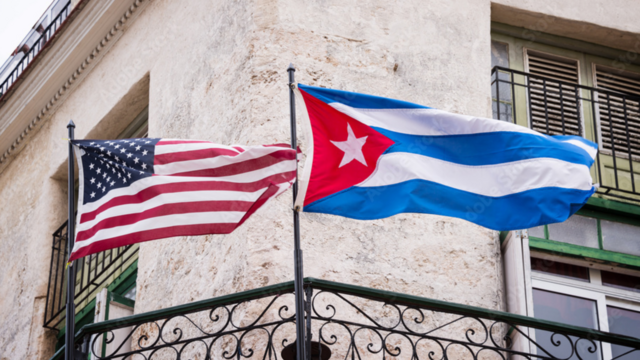
In March 2024, protests erupted across Cuba amid rising food shortages and energy prices. After turning to the United Nations for emergency aid, the government blamed the US for instigating the demonstrations. But while Washington vehemently denies the claims, they have again highlighted the tense relationship between the two countries. So, what was exactly behind that crisis, and could the Communist Regime in Cuba really be on the verge of collapse? Many neighboring countries have strained relations; however, few examples are quite as interesting as the tensions between the United States and Cuba. Despite being the world's most powerful state, the US has had a long, complex, and often embattled relationship with this small island for over 60 years.
Cuba has a long and fascinating history which includes being the subject of Christopher Columbus' 1492 voyage to the New World. In the 16th & 17th centuries, Cuba became an important part of the Spanish Empire in the Western Hemisphere, serving as a staging post from which Spain operated in other areas of the Americas. Cuba was a prominent port of call on the return voyages of the Spanish treasure fleets to Europe. It became an important agricultural hub, growing tobacco and sugar. However, while most of Spain's American empire was lost in the first quarter of the 19th century, Cuba remained under Madrid's control. As a result, pressure for statehood grew. This led to the Cuban War of Independence in 1895.
Following several years of fighting, the turning point came in 1898 when a US warship exploded in Havana Harbor, prompting Washington to declare war on Spain. Just months later, the Spanish government sued for peace. Cuba came under U.S. control under the Treaty of Paris. Four years after its independence in 1902, the country was plagued by political instability marked by frequent changes in changes and revolts. During these years, the United States continued to exert great influence over the nation’s affairs.
Also read: Will China’s Rising Economy Make it a Hegemon?
In addition to establishing a naval base at Guantanamo Bay, which remains under heavily guarded American control even to this day, the US was also given the right to intervene in Cuban affairs, a power that it used on several occasions. Batista oversaw a brutal and repressive regime. This set the stage for an uprising led by young revolutionary Fidel Castro, his brother Raúl, and an Argentinian, Che Guevara. Despite getting off to a bad start with a failed attack on a military barracks in 1956, the guerrilla campaign steadily gained momentum. On January 1, 1959, Batista fled Cuba. Six weeks later, Castro became prime minister. Although Washington initially recognized Castro's government, the relations deteriorated soon after. The turning point came when the new regime nationalized various American-owned properties and businesses without compensation. In retaliation, the US imposed sanctions and a trade embargo and even supported an attempt by Cuban exiles to overthrow Castro, known as the invasion of the “Bay of Pigs”. Castro therefore looked to the USSR for support as he faced mounting economic problems and an increasingly hostile stance from Washington.
Cuba’s reliance on the Soviet Union and the Warsaw Pact enabled it to maintain an acceptable standard of living even under American economic embargoes. However, the Soviet Union's collapse in 1991 changed this, creating many difficulties for the people of Cuba, including shortages of food, medicine, and fuel. However, while Havana implemented strict austerity measures and took initial steps to open the economy to tourism, investment, and private enterprise, Castro nevertheless retained tight control over the country under his one-party system. As a result, Washington, backed by a large and vocal Cuban exile community, hardened its position against the Castro regime, condemning the country's lack of democracy and its restrictions on human rights. Towards the end of the Clinton Administration in the late 1990s, Washington adopted a new approach that eased travel restrictions and opened the way for more significant people-to-people contact. But the détente was short-lived.
When the New Bush Administration took power at the start of 2001, it moved quickly to reinforce the embargo and to impose additional travel restrictions. Fidel Castro, who had ruled Cuba for close to fifty years, passed control of the country to his brother, Raul, in 2008. But just over a year later, another new administration took charge of the USA, this time under President Barack Obama. Relations between the two nations thawed, with cooperation beginning across various areas, ranging from addressing issues related to drug trafficking and migration. This culminated in what proved to be a historic moment in 2014 when both nations formally announced plans to normalize their relationship. They agreed to reopen embassies in both Havana and Washington, ease travel restrictions, and the State Department removed Cuba from its list of state sponsors of terrorism. Crucially, though, the embargo remained in effect, as Congress could lift it. But while it seemed that a new relationship was starting, it proved short-lived again. Citing ongoing human rights violations and Cuba’s support for Venezuela, which was becoming increasingly opposed to the United States, the Trump Administration, which came to power in early 2017, not only reversed many of the steps but also tightened up the long-standing embargo.
Also read: From Caracas to Greenland: Resource Geopolitics and America’s Global Power Recalibration
Although many expected that the Biden Administration would resume efforts to engage with Cuba, especially after Raúl Castro stepped down in April 2021, thus ending 60 years of Castro family rule on the island, there was no return to the Obama-era détente. While steps were taken to ease travel restrictions, the core of the embargo remained intact, as the US continued to cite human rights abuses. Meanwhile, tensions began to grow again in other ways. But despite losing a key ally as the Soviet Union collapsed, Cuba continued to be in good relations with Russia – a fact that was brought to light during the outbreak of war in Ukraine in early 2022. Although Cuba abstained from the General Assembly resolution condemning Russia's invasion of Ukraine, in the face of growing Western sanctions, Moscow and Havana stepped up their economic, political, and military cooperation. Tensions were also stoked by reports that Cubans had signed up to the Russian army, although Havana insisted it wasn't part of the war and vehemently opposed any efforts to recruit its citizens. To add to all this, in December 2023, a former US ambassador was arrested and charged with spying for Cuba over many decades. Several factors explain what’s happening now. Because of the heavy impact of the pandemic on the island, global inflation and fuel shortage issues, coupled with the ongoing effects of US embargo policies, Cuba is experiencing one of the worst economic crises in post-Cold War history.
On 1 March 2024, the government announced a 500% fuel price hike. Shortages of critical items such as baby formula and medicines are rising, prompting an urgent and unprecedented request from Havana to the UN World Food Programme. Moreover, this Caribbean nation has recently experienced a series of power outages. In the face of such serious problems, widespread anger appears to be growing. These issues came to international attention through reports of protests in Santiago de Cuba, the country's second-largest city, as well as in other towns and villages. While Cuban officials insist that steps are underway to address the country's problems, the demonstrations have further heightened tensions between Havana and Washington. Summoning the most senior US diplomat based in the country to the Ministry of Foreign Affairs, the Cuban government directly accused the United States of having a hand in instigating the unrest and interfering in Cuba's internal affairs. In response, Washington has officially denied any involvement in the events, insisting that the accusations are absurd. However, while calling on Havana to show restraint, American officials have also made it clear that Washington fully supports the Cuban people's right to enjoy democracy and fundamental freedoms.
History has shown elsewhere that such situations can rapidly escalate. Meanwhile, both sides have portrayed the protest as part of a larger, longer-term struggle for the Cuban people's right to self-determination. For Havana, it's about a powerful neighbour that has a long history of interfering in Cuban affairs, and which has imposed a punishing and cruel embargo on the country for little more than daring to oppose its control. Meanwhile, for Washington, the confrontation is about ongoing efforts to end a crumbling one-party Communist regime that has deprived the people of Cuba of their democratic and human rights.
Disclaimer: The views expressed in this article are solely those of the author and do not necessarily reflect the official stance of The Himalayan Research Institute Pakistan (THRIP)
_________________________________
Muhammad Haseeb Sulehria is a researcher from Quaid-i-Azam University (QAU), Islamabad, currently pursuing a Bachelor's degree in Defense and Strategic Studies. His research interests include defense, strategic affairs, international relations, and national security.
Contact us

Write with Us
The Himalayan Research Institute is proud to introduce "Himalayan," a dynamic and insightful magazin...
- [email protected]
- +923426470466
- website