
- Opinion Articles
- Basant: A Festival of Colour and Joy
Basant: A Festival of Colour and Joy

Wajeeh Ullah
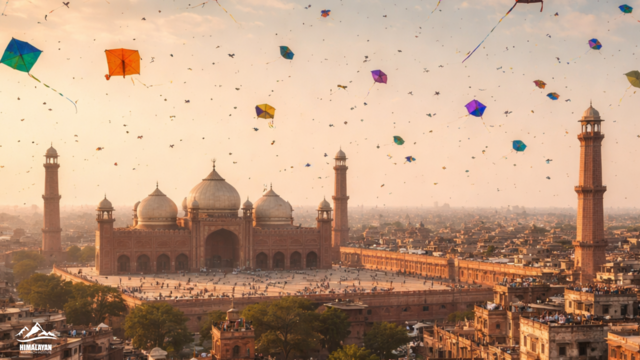
Basant (Punjabi: spring) is a colourful spring festival observed by Punjabis in India and Pakistan. It puts an end to winter and the blossoming of spring, when mustard fields become very yellow. During Basant (celebrated approximately on Hindu Vasant Panchami day), individuals wear yellow, offer puja (in India), and, most notably, fly kites in the open air. Colour and joy: the festival follows the cold months and has become a symbol of Punjabi culture.
Roots and History
The origins of Basant are a mixture of agrarian and cultural cultures. The name itself derives from the Sanskrit word Vasant, meaning "spring," and the festival coincides with the mustard harvest in Punjab. Certain myths associate Basant with Hindu harvest festivals and veneration of Saraswati, the goddess of learning, as Vasant Panchami celebrates her. Sufi folklore introduces an added dimension: a 13th-century legend about Amir Khusro singing to his dying master and cheering him with music and yellow garments, which made it an annual festal tradition.
By the 19th century, Basant had royal sponsors. It was institutionalised in Lahore by Maharaja Ranjit Singh of the Sikh Empire as a state celebration.
On the Basant day, he and his queen would go out kite-flying in their yellow dresses. During their reign, Basant became a major festival, featuring music, decorated rooftops, and large gatherings. Basant remained popular in Punjab, across both rural and urban areas, even after the fall of the empire.
A Festival for Everyone
People of any kind celebrate Basant. It has social value in terms of solidarity across class, religious affiliation, and geographic regions. For example:
In undivided Punjab (before 1947), Hindus, Sikhs, and Muslims alike went out onto the rooftops of their homes on Basant Day, flying kites and eating festive dishes. It was technically a nonreligious spring festival in Punjab.
Punjabis of all ages gather. Schoolchildren, parents, and grandparents wander open spaces or flat roofs to launch kites into the air. Such meetings bring together older and younger generations, and those who meet only once a year unite over snacks, drums, and laughter.
Basant cuts across the wealthy world. An example of this is the reported leasing of prime rooftops in the Walled City of Lahore in 2026 for millions of rupees. Simultaneously, small street vendors and regular families could share the same festival, flying simpler kites and eating local cuisine.
Festivals: Basant in India vs. Pakistan.
In the present day, the Basant practices are still practised on both sides of the Punjab border, though they do not have the same tastes:
In Punjab, India, Basant Panchami is deeply religious. The followers put on yellow attire and praise Saraswati, the goddess of learning. Playing with kites is not the only fun thing to do, but school prayers and puja are also characteristic of the festival. Basant fairs, complete with swings, rides, and sweets, are held in villages and towns - a well-known Basant fair in the Sangrur district is held every Basant Panchami at a Shiva temple. No government prohibits kites; people from different communities enjoy Basant (Hindus, Sikhs, and others) as a spring festival.
Pakistan, Punjab: In particular, in Lahore, Basant is a traditional kite-fighting event. Neighbours strung lights and flags on rooftops, rented rooftops as party spaces, and even conducted formal schools for kite flyers by the end of the 20th century.
But in 2007, kite flying was prohibited for safety reasons. To this day (almost 20 years), Pakistanis were celebrating covertly (in Rawalpindi, one of the vendors was selling kites despite the ban), but any open celebration was stampeded.
Regardless of these variations, both still share the colourful kites and yellow clothes of Basant. The period of 1 day around Vasant Panchami, and the communal happiness of kite fighting are highly comparable in Indian Punjab, as well as in Pakistani Punjab.
Ban, Revival, and Debates
Basant has been controversial in Pakistan. The reason was mostly safety: dangerous kite strings had seriously injured or killed people. In 2007, Basant was banned by Pakistani authorities following numerous accidents caused by bullets and celebratory shots, glass and metal shards that cut motorcyclists, and electrocution caused by kites touching power lines. For example, metal kite wires and shrapnel-like strings have been recorded as major causes of the ban.
Opponents claim that this ban cut off a section of the Punjabi heritage. Many Lahoris recall Basant as a favourite childhood party, and it was impossible to teach children how to play with kites. As one of the fathers explained, when the festival returned, it was like learning to ride a bicycle, a basic skill that his parents had also taught him. The loss of that culture has prompted activists to campaign for the festival's reinstatement.
There has also been a political and legal controversy. A newspaper column in 2004 associated Basant with a legend of blasphemy (the story of Haqiqat Rai) to disapprove it, and even a lawsuit averred that Basant was merely a Hindu practice. In 2005, celebrations in the city were briefly banned by the Lahore High Court on religious grounds. In late 2025, when Punjab finally repealed the ban, officials were quick to deny that Basant is merely a Hindu custom, asserting that it is an inherent Punjabi custom.
Safety concerns: Manjha strings were sharp, cutting riders and birds, and falling off the roof was common. When metal kite touchpoints were on power lines, short circuits occurred, leading to blackouts.
Religious/Legal controversies: The proponents emphasised Basant's secular background. The government statements in response to the critics pointed out that both Hindus and Muslims, as well as Sikhs, used Basant in the past.
Cultural expenses: cultural critics of the ban observe that, for a succession of young people, Basant was merely a legend. One kite flyer remarked that people who have grown up in the past 20 years know nothing about the activity we were taught in childhood. Restoring Basant is widely regarded as a means of maintaining Punjabi identity.
The Return of Basant (2026)
The Basant was officially revived in Punjab, after almost twenty years, by the government. In December 2025, a three-day festival (Feb 6-8, 2026) was sanctioned in Lahore. The authorities were strict: cotton kite strings were granted permission only (glass or metal-coated Manjha was still prohibited), kite sellers were to be registered, and wooden rods were attached to the motorcycles, which would not allow the strings to be tangled. Big kites were outlawed, and drones and nets were employed to retrieve loose strings along power lines.
New safety regulations are prompting Lahoris to stock up on thousands of cotton kite strings before Basant 2026.
The 2026 Basant created a holiday hype. The media reported that rooftop rentals were being charged at astronomical rates (some paid 2-5 million rupees each), that kite and food markets flourished, and that the local economy saw a 10 million rupee shot in kite sales. Old streets became colourful: the walls were yellow, the lamps were lit throughout the night, and the families were ready to make their guests nice sweets and dinners. Individuals shared a million pictures of kites in the sky and wore big grins as Basant flyers rekindled past friendships.
The leaders of Punjab rejoiced in their return. On February 9, the Chief Minister urged the public to celebrate responsibly and described Basant as a vital part of Punjab's legacy. Several Lahoris experienced a nostalgic victory: according to one lifelong fan, the festival has regained the space in his life it once occupied. The NDA Television reported that parents have taught their children to fly kites, with many children having their first Basant since childhood, having been brought up during the ban.
Nevertheless, for many Punjabis, the 2026 festival was a reclamation of a lost cultural tradition. Owners of small businesses - kite-makers, sweet-shop vendors - were also quoted saying that their businesses boomed as Basant provided them with livelihoods. In Lahore, early on Feb 6, yellow kites flew again, a pledge of community and renewal that Punjab has long known.
Disclaimer: The views expressed in this article are solely those of the author and do not necessarily reflect the official stance of The Himalayan Research Institute Pakistan (THRIP)
_________________________________
Wajeeh Ullah is a BS Political Science student at Government College University Lahore, Pakistan.
Contact us

Write with Us
The Himalayan Research Institute is proud to introduce "Himalayan," a dynamic and insightful magazin...
- [email protected]
- +923426470466
- website