
- Opinion Articles
- Iqbal’s Idea of an Ethical Economy: An Influence from Lenin
Iqbal’s Idea of an Ethical Economy: An Influence from Lenin
Minahil Zubair
وہ کلیم ہے تجلی، وہ مسیح بے صلیب
نیست پیغمبر و لیکن در بغل دارد کتاب
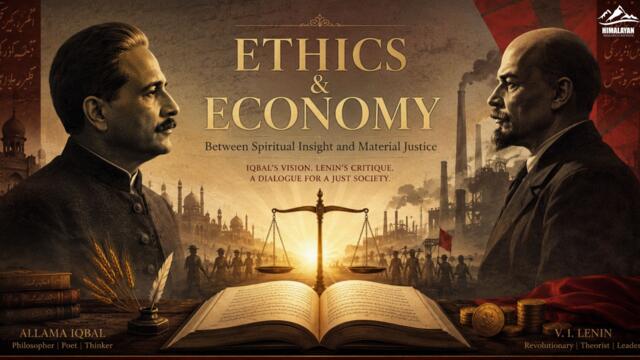
Lenin and Iqbal were influenced by the same Marxist philosophy, and these poetic lines show that. The prevailing nature of almost all economic structures in modern times is one of profit maximisation and efficiency. Such economic principles are essential for progress, but always come at a price. For example, many contemporary societies face issues such as inequality, labour exploitation, and inequity in resource distribution. All of these problems have been recognised and criticised long ago. For instance, the Russian revolutionary Lenin and philosopher-poet Allama Iqbal paid particular attention to the problems in question.
After the Russian Revolution, Lenin became a renowned political figure and an influential Marxist ideologist who advocated revolution against the existing social order. His philosophy was profoundly anti-capitalist, as he viewed capitalism as an inherently exploitative and unjust system of power where labourers' welfare is sacrificed in favour of profits. While operating in a completely different cultural context and intellectual environment, Iqbal was equally interested in critiquing economic injustice. Engaging with the philosophical heritage of such a global thinker as Lenin, he reflected on the existing social-economic problems but chose an alternative path. Namely, instead of revolutionary upheavals, he elaborated the notion of a virtuous economy.
کب ڈوبے گا سرمایہ پرستی کا سفینہ ؟
دنیا ہے تری منتظر روز مکافات
These lines are talking about capitalism, how it has been a burden on the lower class, and when it will end, so that this burden is finally lifted. One of the most significant problems in the current economy is the disparity between the profits and the people. Despite capitalist societies being efficient at creating wealth, they are not effective at distributing it. This leads to:
· The exploitation of workers
· Wealth accumulation by elites
· Widening gap between the poor and the rich
· Neglecting the well-being of humanity
While workers play a critical role in the production process, they are paid inadequately. On the other hand, corporations and individuals continue accumulating wealth. The end result is an economic system that fails to ensure social justice in its development. Various approaches to these problems have been suggested by different scholars. Lenin adopted a revolutionary approach, while Iqbal opted for an ethical one.
Lenin's Perspective on Economics
There is an undeniable connection between Lenin's perspective on economics and Marxism, which holds that history has been a constant conflict between different classes, predominantly the labouring class and the capitalist class (the capitalists).
From Lenin's point of view:
· Labourers produce the true value of everything
· Capitalists gain surplus profit by exploiting labourers
· Accumulation of wealth under capitalism is unfair
· Reformation of capitalism will not happen – it needs revolution
Revolution, according to Lenin, was the only solution that could ensure equality for people. In the course of this process, power would be transferred from the capitalists to the labourers, and the economy would also become state-controlled.
Such an approach to economics greatly emphasised the role of the labourers. It can, however, be called leftist as well due to the high degree of state control.
Iqbal's Connection to Lenin's Teachings
Iqbal belonged to an era in which such transformations were being made. Iqbal was not oblivious to these concepts; instead, he was conscious of them and critical of them.
The problems highlighted by Lenin were also realised by Iqbal:
· Exploitation of workers
· Injustice in the economy
· Unequal distribution of wealth
He appreciated Lenin for standing up to the capitalists and raising awareness of the issue. The evidence is his poem written on Lenin, showing an intellectual connection instead of disapproval.
Verse from Iqbal:
اُٹھ کہ اب بزمِ جہاں کا اور ہی انداز ہے
مشرق و مغرب میں تیرے دور کا آغاز ہے
There have been new developments in the world, and a new chapter has opened where old systems are being questioned. This clearly shows how Iqbal accepted that Lenin's revolution had effects around the globe.
Iqbal’s Concept of the Ethical Economy
While Iqbal was inspired by Lenin's criticism of capitalism, he differed from him in methodology and ideology. Iqbal felt that merely changing the system without changing the nature of the human being would not solve the issue at hand. Iqbal suggested the idea of the ethical economy, which revolves around:
· Justice and equity
· Human dignity (Khudi)
· Responsibility and ethics
· Balanced wealth distribution
Iqbal argued that humans had to become aware of themselves and gain a sense of identity (Khudi), which would help them behave ethically and responsibly. In his view, the economy could not be considered just if the humans living within it lacked moral consciousness. Unlike Lenin, who focused solely on material equality, Iqbal paid equal attention to both material and spiritual progress. Iqbal thought that both extremes of capitalism and socialism could give rise to fresh problems if human beings were overlooked.
Economic Inequality and Labour Exploitation: A Data Analysis
We need to analyse the current economic situation to properly evaluate the relevance of Lenin and Iqbal's viewpoints. Globally, but particularly in developing countries such as Pakistan, there still exist numerous issues related to economic inequalities and exploitation of labour. Globally, 9% of the world's population possesses over 50% of its wealth, whilst the poorest parts fail to meet their basic needs. This indicates that the inequality gap remains a problem pointed out by Lenin. The same holds true for Pakistan, as the following data analysis shows:
· The informal economy employs a significant part of the country's labour force, which lacks job security.
· Many workers receive very low salaries, which are hardly enough to cover the rising costs of living.
· Social safety services (health care, pensions) are unavailable to many workers.
· There exists extreme economic disparity between urban elites and rural inhabitants.
Thus, labourers continue to experience economic difficulties despite being a key element of production. From Lenin's point of view, such statistics will prove the exploitation of workers by capitalists and the accumulation of capital in their hands. It proves that labourers have to be empowered. Lenin's point of view is pertinent in this case. But Iqbal might have his own interpretation of the scenario. He would agree that economic inequality is a problem, but only the transformation of ownership or management will not suffice. Rather, the moral responsibility of all individuals, institutions, and policymakers will be stressed.
Business firms, apart from maximising profits, must take into account fairness in wages and working conditions. Moreover, government policymakers must frame policies that can lead to economic development and the equitable distribution of resources. Such a statistical approach reinforces the view that both Lenin and Iqbal were right. At the same time, Iqbal's proposed ethical economy may offer a better way out of such problems.
Policy Implications
The concept of ethical economy proposed by Iqbal is very pertinent in today’s era. Inflation, unemployment, and income inequality are just a few of the issues we face today, proving that profit-oriented economies alone cannot resolve our problems. On the basis of Iqbal’s theory, some of the policy implications may include:
· Ensuring workers’ rights and providing just wages
· Ethical conduct in business
· Decreasing economic exploitation
· Social welfare policies
· Achieving economic growth alongside justice
These policies address not only the economic aspects of society but also the moral aspects of the economy.
Conclusion
Lenin and Iqbal have both identified many issues with capitalist systems, such as exploitation and inequality. Lenin's response was revolutionary, as he developed a new model in which labourers were empowered, and equality prevailed. Although this idea brought about significant changes, it may be considered too radical since it involved extensive use of state power. Unlike Lenin’s approach, Iqbal’s addressed the same problem but took a different route. This philosopher focused on developing an economy based on justice and dignity, which means that people must change their ways before a positive transformation can be achieved.
The need for such an idea is especially evident in today's world, where capitalism no longer cares about human values.
Disclaimer: The views expressed in this article are solely those of the author and do not necessarily reflect the official stance of The Himalayan Research Institute Pakistan (THRIP)
_________________________________
Minahil Zubair is a Development Studies major at Bahria University and a researcher at REI. She is passionate about writing and research, with a strong interest in exploring social issues and development-related topics through academic and creative work.
Contact us

Write with Us
The Himalayan Research Institute is proud to introduce "Himalayan," a dynamic and insightful magazin...
- [email protected]
- +923426470466
- website