
- Blogs
- Debt, Dependency & Development: How IMF Conditionalities Reshape Pakistan's Economic Policy and Who Pays the Price
Debt, Dependency & Development: How IMF Conditionalities Reshape Pakistan's Economic Policy and Who Pays the Price

Moiz ur Rehman
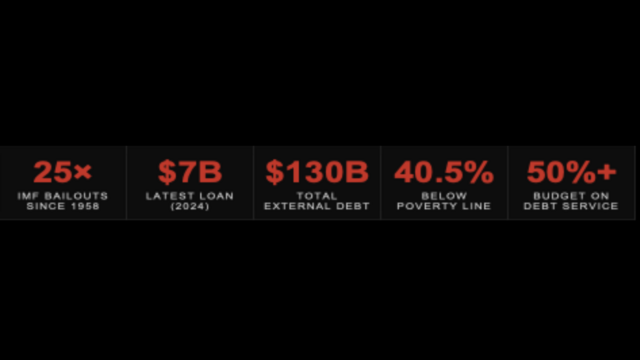
Since 1950, Pakistan has entered into 25 loan agreements with the IMF, an average of one every three years. Each program, rather than leading to graduation from financial dependency, sets the stage for the next. This is not a story of crisis management, but of a structural condition of subordinated sovereignty.
The conditionalities of the IMF, such as austerity, subsidy removal, tariff increases, and regressive taxation, are aimed at macroeconomic stabilisation within a neoliberal framework that treats inflation control and fiscal consolidation as ends in themselves. But stabilisation without equity is an empty aspiration for a country like Pakistan, with 25 million children out of school, health spending down to just 1pc of GDP, and electricity prices up over 110pc since 2019.
The 2024 program was conditional on tax rises, changes to energy tariffs and governance overhauls. What is then the result? Petrol prices up 840pc since 2019. The World Bank estimates that 40.5pc of Pakistanis are now below the poverty line, 2.6 million more being added in 2024 alone.
Pakistan’s external debt jumped from $37.2 billion in 2006 to $130 billion in 2024, a 250pc increase in 18 years. More than half of the national budget is spent on servicing the debt – the equivalent of 105pc of all taxes collected. The country borrows to pay its debts. That’s the dependency trap at work.


67 Years of Borrowed Time: Key IMF Milestones
|
|
2008 — LARGEST LOAN IN HISTORY Global Crisis Hits Pakistan As the global financial crisis hit and foreign reserves were running low, the Gillani government sealed Pakistan’s biggest-ever IMF loan at the time. $7.6 BILLION |
|
|
2023 — BRINK OF DEFAULT Emergency Stand-By Arrangement Pakistan is heading toward a near-default situation due to political chaos, the fallout from the pandemic and 2022 floods that led to $30 billion in losses. $3B SBA with heavy prior actions taken. $3 BILLION (SBA) |
|
|
2024 — BAILOUT #25 The Latest $7 Billion Program Pakistan's 25th IMF program approved. External debt soars to $130B. Poverty, 40.5pc. Conditions Tax hikes, energy tariff reform, SOE privatization. $7 BILLION (EFF) |
What Pakistan Agrees to And Who Bears the Cost
|
|
⚡ Energy Tariff Hikes Under the IMF programs, electricity prices have shot up from Rs 10 to Rs 65 per unit, the highest in the region. Gas prices are up 840pc since 2019. It harms rural and low-income households and undermines industrial competitiveness.
|
|
|
? Regressive Taxation GST increased to 18pc. Indirect taxes account for 60pc of total tax revenue, placing a disproportionate burden on the poor. The rich agrarian and trading sectors are still largely outside the formal tax net.
|
|
|
✂️ Subsidy Removal Systematically dismantled fuel and food subsidies. Consumer buying power fell 38pc in 2023. Food insecurity currently affects 16pc of the population – exceeding emergency thresholds in many areas. |
|
|
? Privatization Mandates Required to sell state-owned companies. Failed attempt to privatize PIA in 2024. SOEs received PKR 905 billion in subsidies in FY22–23 but political economy makes structural reform very difficult. |
|
|
?️ Fiscal Consolidation To reduce the fiscal deficit to 5.9pc of GDP, public investment will need to be cut. The debt service is increasing; the development budget is decreasing. Sacrificing long-term growth for short-term macro-economic metrics. |
Pathways Beyond the Dependency Trap
|
|
|
|
|
|
|
05 Democratic Conditionality Reform IMF conditionalities must be debated in parliament and scrutinized by civil society. Pakistan should push for governance reform at the IMF in the G24 that enhances the voice and voting power of borrowers. |
|
|
|
|
Conclusion:
25 bailouts have not brought development; they have brought dependence. The IMF offers a fire extinguisher, while the structural conditions that ignited the fire remain untouched: a narrow tax base, weak exports, elite capture, and a foreign policy that barters economic sovereignty for geopolitical usefulness.
Disclaimer: The views expressed in this article are solely those of the author and do not necessarily reflect the official stance of The Himalayan Research Institute Pakistan (THRIP)
_________________________________
Moiz ur Rehman is a Research Intern at Rethinking Economics Islamabad, where he produces analytical work on developmental economics and emerging technologies. He holds an MSc in Economics & Economic Policy from the Higher School of Economics, Russia. He is dedicated to fostering interdisciplinary approaches to economic growth and structural reform and can be reached at [email protected]
Contact us

Write with Us
The Himalayan Research Institute is proud to introduce "Himalayan," a dynamic and insightful magazin...
- [email protected]
- +923426470466
- website