
- Opinion Articles
- America’s New Monroe Doctrine: Power, Pressure, and the Future of the Americas
America’s New Monroe Doctrine: Power, Pressure, and the Future of the Americas

Muhammad Haseeb Sulehria
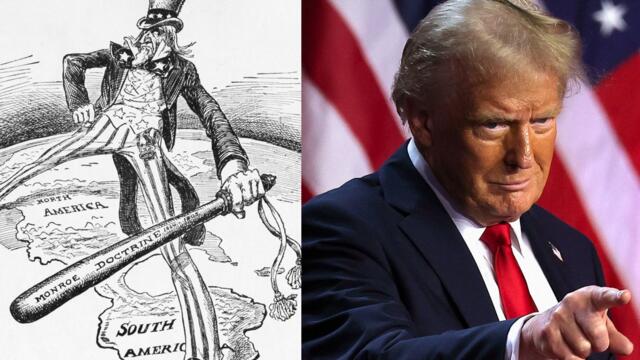
Is the United States really retaking control of the Americas? For more than two centuries, US foreign policy has been driven by the belief that it has a special sphere of influence over the region. However, in recent decades, a new approach has seemingly emerged based more on economic and political cooperation than military coercion. That was until now. Under the Trump administration, there has been a new push to dominate its hemisphere. From threats against Mexico and Panama to suggestions of annexing Canada and Greenland, the United States has made it clear that it desires to control the Americas. But what exactly underlies all this? And can it possibly succeed?
Historically, there have been attempts by dominant powers to create spheres of influence. These are areas where they feel special privileges or rights and where they feel their rivals will limit their presence. Though rarely formalized, such an arrangement is highly protected. This happened during the Cold War when Europe was split into rival spheres of influence controlled by the US and the USSR. But one of the most historically significant and enduring spheres of influence has been the US claim over the Western Hemisphere.
From the early 19th century onwards, Washington has maintained that the Americas are its special zone of concern. The rest of the world, be it Europe or any other foreign power, needs to stay away from America's affairs. On the other hand, it has also established its authority by intervening many times and toppling governments, building economies, and defining regional security. The story begins in the last part of the 18th century when the United States came into being as a nation. Being a nascent republic, wary of getting caught up in European competition, the founding father of America, George Washington, warned about permanent alliances and emphasized trading and diplomacy over any sort of conflict. Hence, for the first few decades, this nation had the tendency to keep itself and focus more on developing its economy and securing its future. All this, however, was to change with the advent of the 19th century.
As Europe was ravaged by the Napoleonic Wars, Spain's empire in Latin America began to disintegrate. New countries emerged inspired by ideas of nationalism and the US model of governance. But for the United States, this transformation brought both risks and opportunities. While it welcomed the spread of republican ideas, it worried that European powers might try to reassert control either by restoring Spanish rule or by establishing new colonies. And it was in this context that President James Monroe presented a new foreign policy vision to the US Congress in 1823, in what would later become known as the Monroe Doctrine. He stated that the Western Hemisphere was no longer open to European imperialism and that any attempts to extend their control would be seen as a threat to the United States. In return, he assured them that the US wouldn't interfere in European affairs or challenge their existing colonies in the Americas, including Britain's possessions in the Caribbean. While the Monroe Doctrine is now regarded as an important assertion of US authority, at the time it was little more than a declaration of intention rather than a display of actual power. Nonetheless, it marked a turning point.
The United States had clearly claimed a special role over the Americas. Despite its modest start, the Monroe Doctrine evolved considerably over the course of the 19th century. As the United States expanded, industrialized, and grew in power, it began to interpret the doctrine more and more assertively. What originally served as a warning to European empires was turned into a justification for American dominance, if not imperialism. This policy was formally established early in the 20th century by President Theodore Roosevelt.
Under what is known as the Roosevelt Corollary, the U.S. government took upon itself the right to intervene in the affairs of Latin America, not just to stop any involvement by Europe in these affairs but also to stop domestic disturbances or instabilities. This is why, in the years that followed, there were many interventions and occupations designed to overthrow the ruling regimes and reorganize the political structures of the Americas according to the needs of the United States. Although such rhetoric could sometimes become softer, as seen under the Good Neighbor Policy of Franklin Roosevelt in the 1930s, this was just cosmetic. Despite this seeming dominance, the Cold War marked the start of a new chapter. For the first time in over a century, US control across the Americas was now challenged by a new actor, the Soviet Union. The decisive moment came with the 1959 Cuban Revolution. As the new government in Havana aligned with Moscow, it directly challenged the US claim to regional authority. Consequently, the reactions of Washington were extensive and quite ruthless. To block the advance of communism, Washington backed up coups and helped oppressive regimes come into power and prevented the emergence of leftist groups in politics. Indeed, Washington became a key factor influencing Latin American politics for decades.
But with the end of the Cold War era, something had to be changed in the policy of the United States. Without the Soviet menace, the US stopped using coercion in its international relations and concentrated on the development of democracy and economic liberalization. Therefore, the Monroe Doctrine seemed outmoded. While the US was still actively engaged in the region, it seemed that its long history of harmful interference had largely ended. That was until now. While the first Trump administration tried to assert some degree of control over the Americas, it tended to be chaotic and inconsistent. However, all this has changed in his second term. Senior officials have spoken openly about US control over the Western Hemisphere in strikingly explicit terms, often calling for a revival of the Monroe Doctrine. Since taking office in January 2025, the world saw a run of extraordinary statements and actions from the Trump administration. As well as threatening to use force against cartels and hinting at military action in Mexico, Trump has threatened to retake control of the Panama Canal and floated ideas about annexing Canada and taking Greenland from Denmark. In Brazil, his administration has used tariffs and sanctions to try to shape domestic politics. And in Honduras, Washington openly attempted to influence the country's presidential election. But the most traumatic development has been in Venezuela. On the 3rd of January 2026, US forces seized the country's president, Nicolás Maduro, in a surprise operation and transferred him to the United States to face major drug trafficking and narco-terrorism charges.
In the aftermath, Trump declared that American officials would temporarily run the country, pending what he called a proper transition, whatever this might mean. And looking ahead, fears are growing that this is just the start of a far more aggressive assertion of US regional power. For instance, following the Venezuela operation, it was noticeable that the US Secretary of State, Marco Rubio, refused to rule out the possibility of using force against Cuba as well. Similarly, there is renewed emphasis on gaining control over Greenland, which has prompted the Danish prime minister to ask Trump to scale back on the rhetoric of his government.
Is this all a new version of the Monroe Doctrine? And if so, can it succeed? On the first question, many would argue that the doctrine never truly disappeared. It's simply faded into the background during a period of unchallenged US primacy. In this sense, it's merely been reasserted as that control comes under greater challenge. As for whether this aggressive new approach can possibly succeed, the United States clearly retains overwhelming advantages. It remains the most powerful military actor in the hemisphere. Its economy remains deeply entwined with those of its neighbors, and its cultural influence continues to be immense. Added to the fact that it still has key regional allies such as Argentina's Javier Milei, and that its show of force in Venezuela will undoubtedly force many other leaders to rethink whether they really want to take on Washington, many feel that the US is well on its way to securing control over the entire continent.
On the other hand, it can also be argued that the world has changed too much for such an approach to work. The era of Latin America being seen as a collection of vulnerable and isolated states is gone. In an interconnected global world, power becomes increasingly difficult to exert and easy to resist. While Russia may not have been able to help Maduro, China has emerged as a big player economically in the whole region. In this sense, heavy-handed US interventions risk pushing governments closer to rival powers and blocs such as Beijing and the BRICS or serve as an impetus for greater economic cooperation with the European Union. Added to this, while threats to annex Canada or seize Greenland may certainly command media attention, they also alarm key partners and allies and erode trust. All this will in turn steadily undermine US power. Maybe not immediately, but eventually.
Ultimately, though, both camps may be correct. In the short term, Trump's efforts to aggressively resurrect the Monroe Doctrine may well secure immediate military victories and bend countries to his will, as we've seen in Venezuela. However, one suspects it'll also lead to resentment and lay the foundations for many countries to look to other powers also seeking to increase their control. To this extent, by taking such a heavy-handed approach to try to restore the Monroe Doctrine, Trump may well in fact be securing US political decline not only across the Americas, but also across the world more generally.
Disclaimer: The views expressed in this article are solely those of the author and do not necessarily reflect the official stance of The Himalayan Research Institute Pakistan (THRIP)
_________________________________
Muhammad Haseeb Sulehria is a researcher from Quaid-i-Azam University (QAU), Islamabad, currently pursuing a Bachelor's degree in Defense and Strategic Studies. His research interests include defense, strategic affairs, international relations, and national security.